
Materials that are both ferroelectric and magnetic—multiferroics—are rare. This is because in most ferroelectrics, such as BaTiO3, the ferroelectricity is driven by a hybridization of empty d orbitals with occupied p orbitals of the octahedrally coordinated oxygen ions. This mechanism requires empty d orbitals and thus cannot lead to multiferroic behavior. There are consequently very few ferroelectrics that exhibit long range magnetic order, and rarer still are materials where these two disparate order parameters exist and exhibit significant coupling. Multiferroics have been of particular interest recently both to understand the fundamental aspects of the novel mechanism that gives rise to this magnetic-ferroelectric coupling, as well as because of the intriguing possibility of using these coupled order parameters in novel device applications. In particular, recent "proof of principle" work has shown that it is possible to control the magnetic phase with an applied electric field, and control the electric polarization with an applied magnetic field. One of the most promising candidates of this type is PbFe0.5Ta0.5O3. In this contribution we present dielectric properties of PbFe0.5Ta0.5O3 ceramics in wide temperature (130 – 450K) and frequency (0.2- 2000 kHz) range.
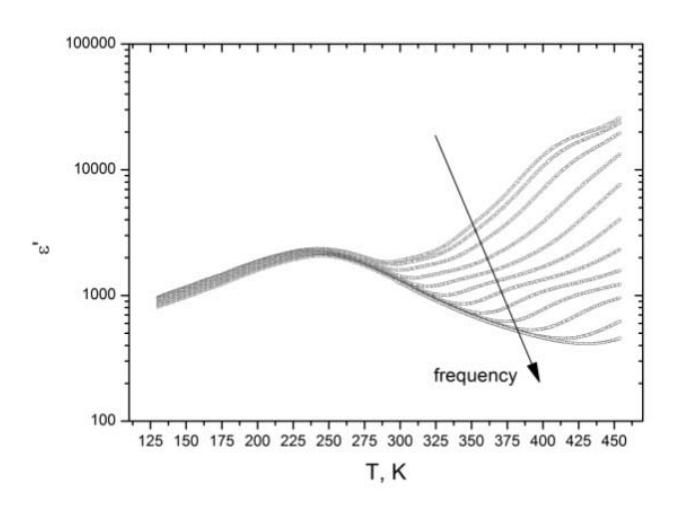
Dielectric measurements of complex dielectric permittivity $\epsilon^* = \epsilon' -i\epsilon''$ of the PbFe0.5Ta0.5O3 show only one phase transition at a Curie temperature ~ 240 K (Fig. 1). At this temperature real part of dielectric permittivity $\epsilon'$ reaches a maximum value (around 2250), which is dependent on frequency.
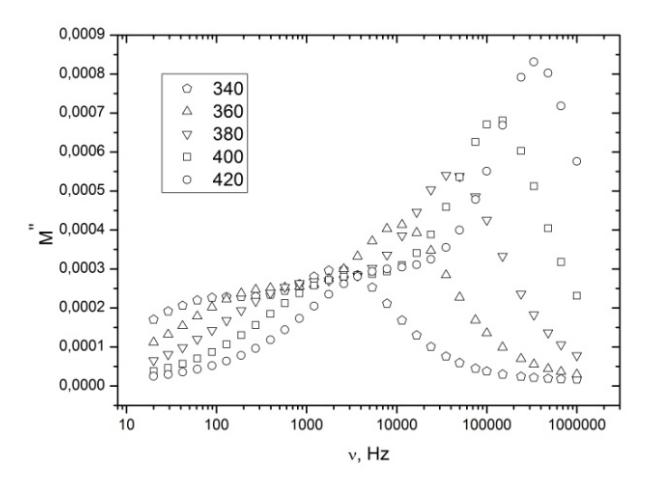
As it is possible to see from the fig.1., the dielectric properties at high temperatures are dominated by electrical conductivity. Due to that, the complex electric modulus of PbFe0.5Ta0.5O3 has been calculated at the high temperatures according to the equation $M^* = 1/\epsilon^*$. The obtained frequencies dependencies of imaginary part of electric modulus are presented in Fig. 2.
In Fig. 3 the peaks positions of $M''$ are presented versus the temperature. Using this plot the activation energy has been calculated: $E_A/k_B = 9064$ K.
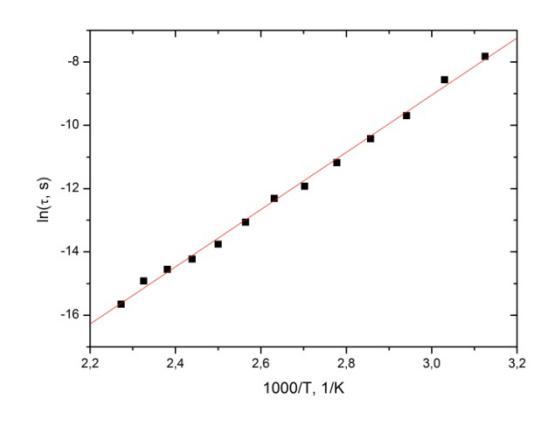
The obtained value of the activation energy show, that conductivity is caused by oxygen vacancies migrating in the PbFe0.5Ta0.5O3 lattice.