
Laser Three-Dimensional (3D) photostructuring of polymers allows production of various photonic and optical components, electromechanical systems and other objects in micro- and nanoscale. Currently, there are a range of techniques to obtain micro/nanoobjects, such as self-organization, electron beam lithography and nanoimprinting. However, optical fabrication employing ultrafast pulses provides unmatched flexibility and true 3D structuring [1].
In this work, Femtosecond Laser Two-Photon Polymerization (FLTPP) method was applied to produce 3D microstructures for tissue engineering applications. Ultrashort pulsed laser beam is tightly focused in the bulk of the photosensitive material, thus nonlinear light and mater interaction creates small region of photomodified volume in the vicinity of focus. This induces photopolymerization reaction and forms non-soluble polymers from initial monomers. By moving laser light focus we can directly write complex 3D structures in photopolymer directly from Computer Aided Design (CAD) model. Using this approach fabrication spatial resolution can reach few hundred nanometers [2].
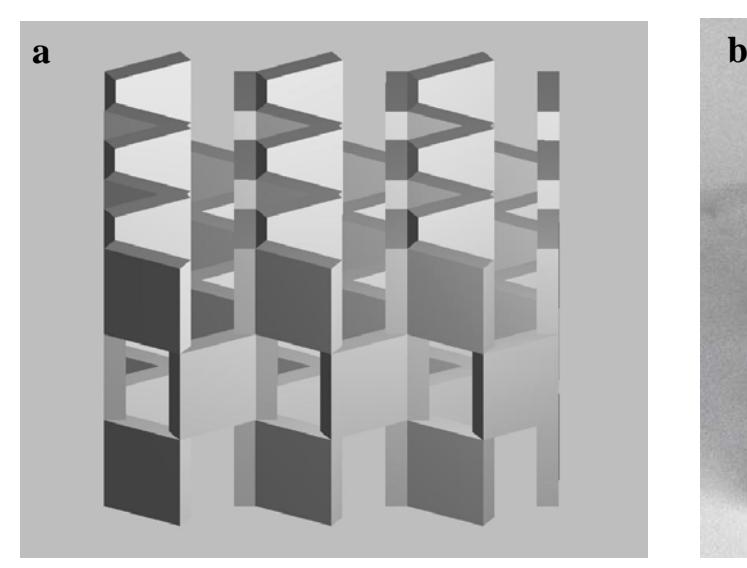
FLTPP is attractive technology for tissue engineering applications. Nowadays, complex form polymeric matrices are designed for primary stem cell growth. It can serve as artificial scaffold for growing tissue. Therefore, the demand in technologies for 3D cell culture scaffolds is required. FLTPP provides unique possibility of 3D sculpting without geometrical restrains and it satisfies the resolution needed for artificial scaffolds. Also, depending on final application biocompatible or even biodegradable polymers can be used. However, much of efforts are still needed to be invested in order to improve fabrication throughput of technology and cell behavior studies at microscale in third dimension [4].
In this paper, we present the 3D scaffolds fabricated via FLTPP technique and their biocompatibility investigation using rabbit myogenic stem cells.