
Isoelectronic doping of GaAs allows significant modification of its electronic parameters. By substituting As atoms with larger Bi atoms, bandgap narrowing (of up to -62 meV/%Bi) and subpicosecond carrier lifetimes are observed, thus making GaBiAs a potential material for ultrafast photodetectors for the use in infrared communication, as well as for optoelectronic emitters and detectors of terahertz radiation [1]. A bandgap as narrow as 0.74 eV and Bi content of $x=11\%$ has been achieved [2].
Non-equilibrium carrier lifetime and bipolar diffusion coefficient was measured in low-temperature grown (LTG) GaBiAs epilayers and in the LTG GaAs substrate on which they were grown by MBE. The exact Bi content in the samples is not known, however, using data from photoluminescence measurements, it has been estimated to be in the range of 3% to 5.5% in different samples.
The four-wave mixing technique was used in measurements. A transient diffraction grating was induced using the 2nd harmonic (532 nm) of a YAG:Nd laser (PL 2143, Ekspla) and was probed using the 1st harmonic (1064 nm) of the same laser. Time resolution was achieved by increasing the optical path of the probe beam and was limited by the duration of the laser pulse (~25 ps). Diffraction efficiency as a function of excitation intensity was measured in order to investigate recombination processes in the samples.
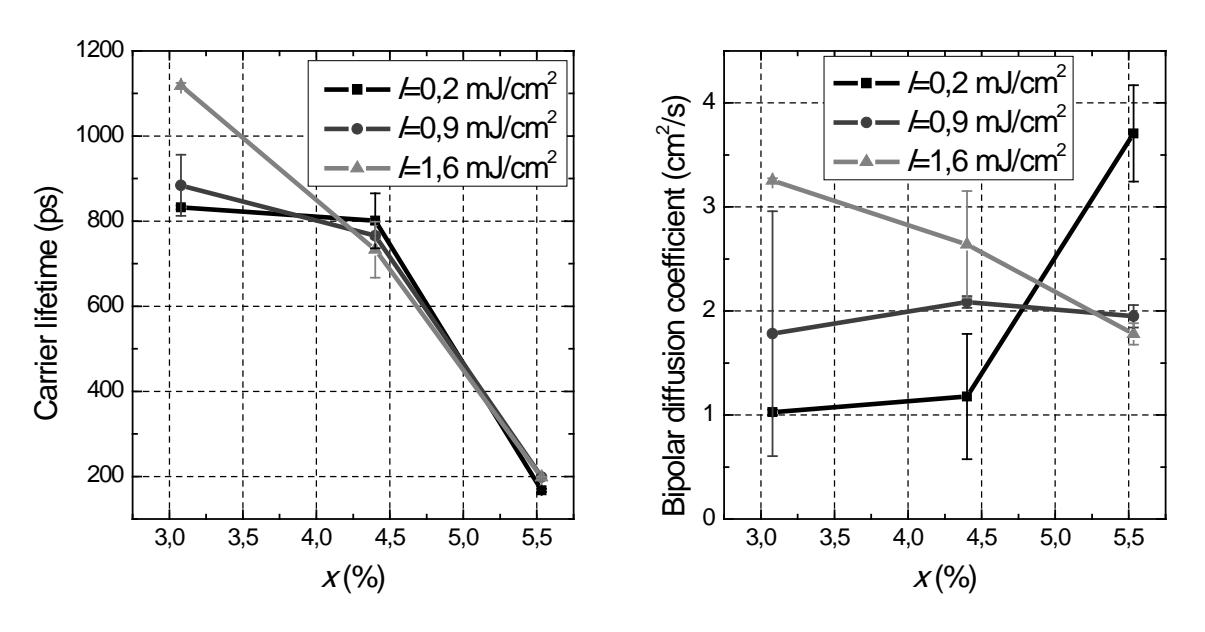
Carrier lifetimes and diffusion coefficients measured at different excitation levels are presented in Fig. 1. Carrier lifetimes decrease with increasing Bi content which can be explained by Bi atoms forming fast recombination centers. The longest observed carrier lifetime was 850-1150 ps and the shortest –180-200 ps. For comparison, the carrier lifetime in the substrate was ~400 ps.
The measured value of bipolar diffusion coefficient (1÷4 cm2/s, which corresponds to hole mobility of 20÷80 cm2/(V·s)) does not change significantly with increasing Bi content, however, it is much lower than that in the substrate (~40 cm2/s) or in GaAs (~20 cm2/s), therefore, Bi incorporation greatly reduces the quality of the crystal.
At excitation intensities above 0,4 mJ/cm2 a faster induced grating decay component has been observed. This effect was not observed in the substrate within the intensity limits of the experiment (up to 4,5 mJ/cm2), therefore, it can be assumed that Bi incorporation increases the non-linear carrier recombination coefficients.