
Optical parametric generation in nonlinear crystals now is mostly useful as a widely tunable
source in UV, VIS and IR spectrum regions. Optical parametric oscillators (OPO)'s are extremely used in spectroscopy and analytical applications. There are two types of OPO's: singly and doubly resonant. Doubly resonant OPO's has lower generation threshold in comparison with singly resonant OPO's, but radiation has cluster structure caused by different longitudinal mode spacing for signal and idler waves. In [1] it was shown possibility to realize clusterless radiation of doubly resonant OPO using different cavities for signal and idler waves (for type-II phase-matching case). Unfortunately the stability of radiation in such OPO's configuration are unstable in order different
cavities mode beating.
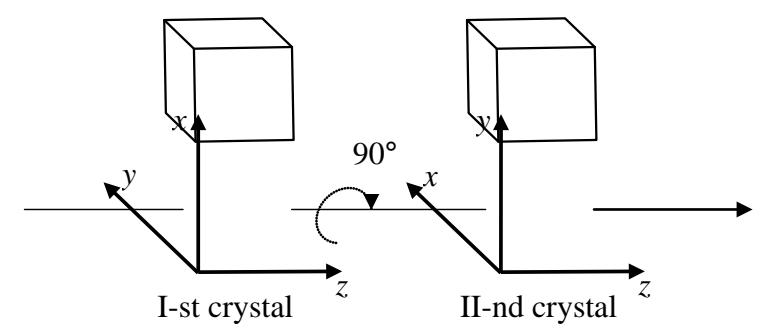
In this report we present results of new configuration design OPO investigation (type-II interaction). In this case into traditional KTP OPO cavity the same length second KTP (10 mm) crystal was inserted. This crystal orientation was orthogonal to first one as shown in fig.1. In this case in the first KTP crystal generated signal (o-polarized) and idler (e-polarized) in second KTP crystal propagates as e-polarized – signal, and o-polarized idler waves. And as a result the cavity
lengths for signal and idler waves are compensated.
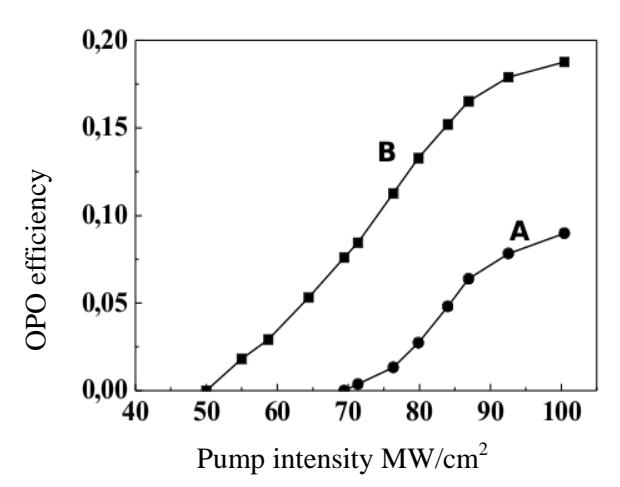
For the KTP OPO pump the laser system consists of microchip laser and Yb doubted fiber amplifier were used. Pulse duration was 1.2 ns, maximum energy – 100 μJ, repetition rate – 2 kHz. It well known that efficiency and generation threshold of OPO strongly depends on the cavity length. In our case only few passes of pump radiation in OPO cavity was realised. Fig. 2 shows OPO efficiency
versus pump intensity for one KTP crystal OPO – A, and B – two KTP crystal OPO. In both cases the OPO cavity optical lengths were the same. Traditional OPO generation threshold was ~70 MW/cm2 (efficiency – ~9 %); two crystals OPO threshold was approximately two times lower (efficiency – 18 %).
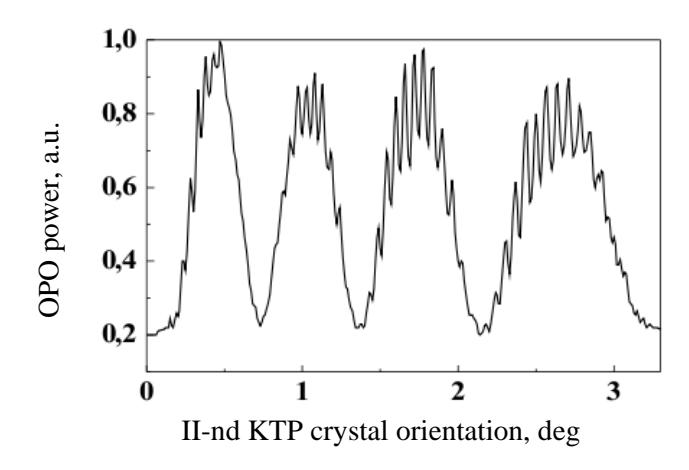
The OPO output intensity strongly depends on the II-nd KTP crystal orientation. It is necessary select direction of signal and idler waves propagation how are shown in fig. 3.
Presented results shows that proposed OPO's configuration allows to decrease generation threshold and increase efficiency of doubly resonant OPO.