KINETIC PROPERTIES OF INDOLO-BENZOXAZINE PHOTOCHROMIC COMPOUNDS INVESTIGATED BY NANOSECOND TIME-RESOLVED SPECTROSCOPY
V. Pranculis1, L. Ivanauskas1, V. Martynaitis2, A. Šačkus2, M. Vengris1
1 Laser Research Center, Department of Quantum Electronics, Faculty of Physics of Vilnius University, Saulėtekio ave. 10, LT-10223 Vilnius, Lithuania
2 Institute of Synthetic Chemistry, Kaunas University of Technology, Radvilėnų Rd. 19, LT-50254 Kaunas, Lithuania
Photochromism is light-induced reversible transformation of a chemical species between two forms having different absorption spectra.
The phenomenon of photochromism was noted as early as 1867 [1], yet the research of the field are still bringing up new facts and results. One of these was the invention of the new organic photochromic compounds of spirooxazine class in 2005 [2].
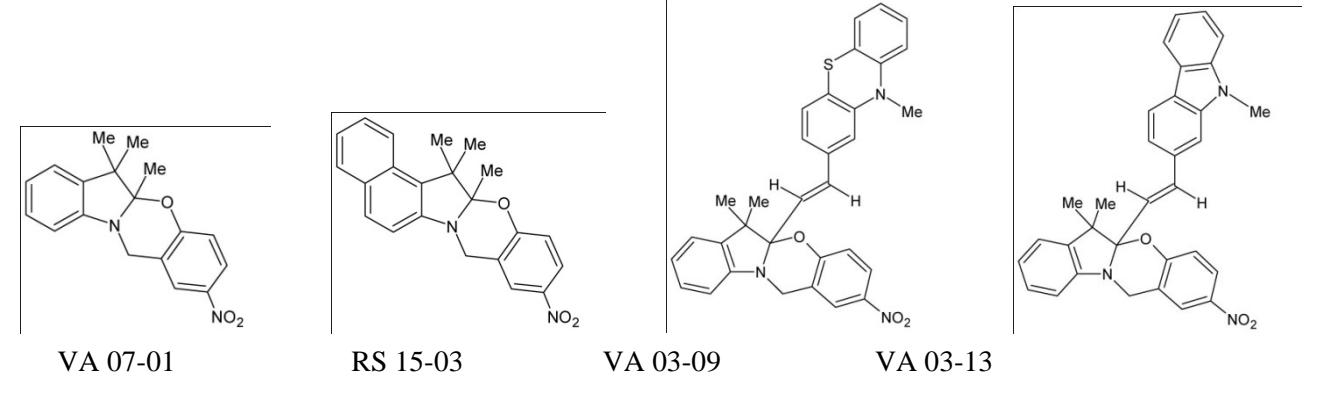
Derivatives of this new dye (indolo [2,1-b] [1,3] benzoxazine, VA 07-01 in Fig. 1) were analyzed by means of nanosecond flash-photolysis in order to estimate the effect of structural modifications of the basic structure (VA 07-01 in Fig. 1). Chemical formulas of analyzed compounds are shown in figure 1.
Fig. 1. Chemical formulas of analyzed spirooxazines.
Samples were dissolved in MeCN and excited by 3rd harmonic of Nd: YAG laser (Ekspla NL301). High-speed photodiodes and 1 GHz bandwidth oscilloscope were used to detect transient absorption of the solution in the selected wavelength. Time resolution of the experiments was limited by the duration of laser pulse (5 ns).
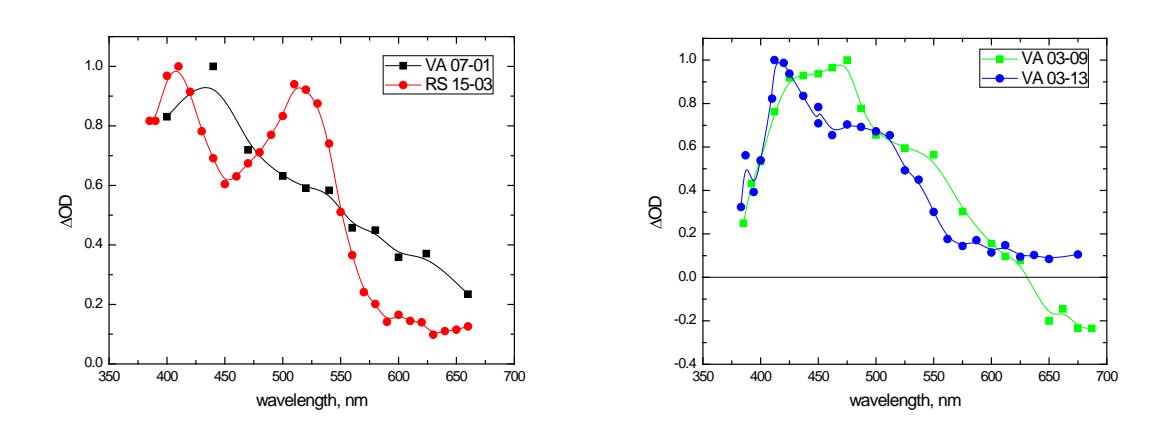
Comparison of time-gated absorption spectra of VA 07-01 and RS 15-03 (Fig. 2.) shows that the absorption maximum at ~425 nm is due to nitrophenolate. This is also confirmed by the nitrophenolate absorption spectra presented in [3]. The strong RS 15-03 absorption band at 525 nm could be due to benzene ring addition to the indoline moiety because it is much weaker in other analyzed compounds.
Fig. 2. Time-gated spectra of analyzed spirooxazines.
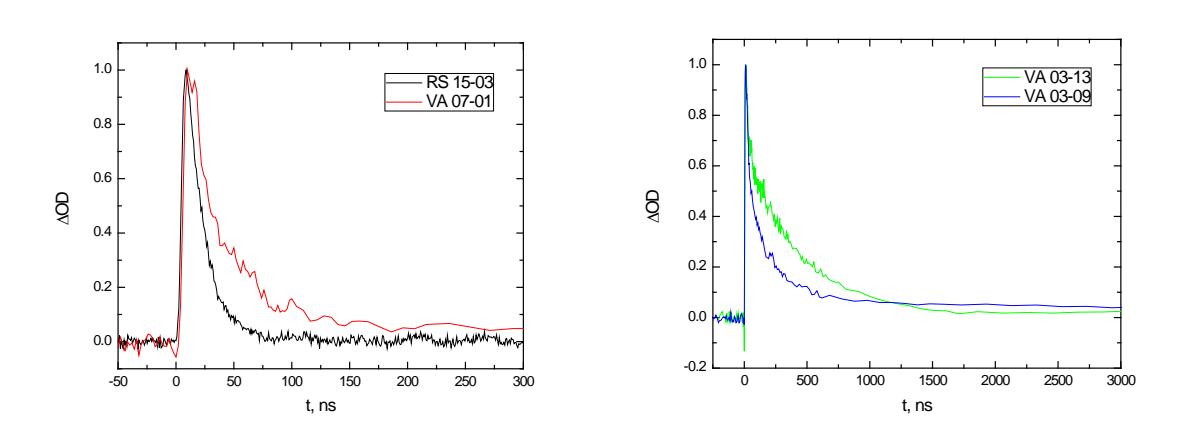
Transient absorption kinetics shown in Fig. 3 imposes that massive chemical groups linked to spiro atom through ethylene bridge prolongs relaxation time to microsecond domain. This can be explained by more complicated geometrical transformation required for returning back to the original form.
Fig. 3. Transient absorption kinetics of analyzed spirooxazines. Note the different time-span of right and left graphs.
Collected data is helpful for understanding and distinguishing roles of different moieties of spirooxazine in photochromic reaction. This roughly allows predicting the parameters of newly designed photochromes.