
Optical poling of azobenzene containing polymers enables us to break centrosymmetry of optically isotropic media creating the second-order nonlinear optical effect [1]. It is important to find new materials, in which the second order susceptibility can be induced. The micro patterning of the second order susceptibility $\chi^{(2)}$ of azo-dye doped polymer films by optical poling is performed by coherent combination of a fundamental field $E_{\omega}$ and the second harmonic field $E_{2\omega}$. The coherent pumping of the electro-optic polymer film results in an orientational hole burning through the quantum interference of two-photon absorption at the fundamental frequency $\omega$ and one-photon absorption at the second-harmonic frequency $2\omega$. The orientation hole burning is followed by a reversible trans-cis-trans isomerization process, which drives optical orientation motion, finally leading to a net permanent molecular polar order and automatically produces quasi-phase-matched $\chi^{(2)}$ micro-pattern for generation of the second harmonic.
Phenomenological model of photoinduced poling dynamics is developed. Given the intensities of the fundamental field and the second harmonic field used in the poling process, generation and relaxation of $\chi^{(2)}$ and $\chi^{(3)}$ nonlinear susceptibilities are described by this model. The physical origin of all-optical poling is attributed to orientational hole burning and molecular reorientation. It includes three parts: the first one is the isomerization of trans transforming to cis back to trans, the third one is the molecular thermal – induced orientational diffusion. The theory developed below is more general for considering the influence of cis on the poling process. Even though the direct contribution of cis to the induced susceptibility $\chi^{(2)}$ is negligible, the population of cis affects obviously the polar order of trans, thus it affects the induced susceptibility $\chi^{(2)}$ [2]. To derive the time – dependent expression of photoinduced poling, we consider the elementary contribution to the polar order made by the fraction of the molecules $dn(\Omega)$ whose representative moment of transition is presented in an elementary solid angle $d\Omega$ near the direction $\Omega(\Theta, \varphi)$. Obviously, time evolutions of the molecular density of trans $n_t(\Omega)$ and cis $n_c(\Omega)$ (Fig. 1.) presented in the solid angle $\Omega(\Theta, \varphi)$ are given by
$$\frac{\mathrm{d}n_{t}(\Omega)}{\mathrm{d}t} = -\xi I(\Theta)n_{t}(\Omega) + \frac{1}{\tau_{c}} \iint P(\Omega' \to \Omega)n_{c}(\Omega') \mathrm{d}\Omega' + D_{t}\nabla^{2}n_{t}(\Omega),\tag{1}$$
$$\frac{\mathrm{d}n_{c}(\Omega)}{\mathrm{d}t} = -\frac{1}{\tau_{c}}n_{c}(\Omega) + \xi \iint Q(\Omega' \to \Omega)I(\Theta')n_{t}(\Omega')\mathrm{d}\Omega' + D_{c}\nabla^{2}n_{c}(\Omega)\tag{2}$$
The three terms in the right sides of (1) and (2) correspond to the three parts described above for trans and cis, respectively. $\xi$ is the quantum efficiency of trans-to-cis photoisomerization, which is mainly related to resonant excitation, laser rate and matrix rigidity. $\tau_c$ represents the lifetime of cis. $P(\Omega' \to \Omega)$ and $Q(\Omega' \to \Omega)$ are the probabilities for molecules to rotate from $\Omega'$ to $\Omega$ in the process of cis-to-trans thermal recovery and trans-to-cis optical transition respectively. $D_t$ and $D_c$ are the thermal-induced orientational diffusion constants for trans and cis. $n_t(\Omega)d\Omega$ and $n_c(\Omega)d\Omega$ are the number of trans and cis which orient in the elementary solid angle $d\Omega$ around the direction $\Omega(\Theta, \varphi)$ [2].
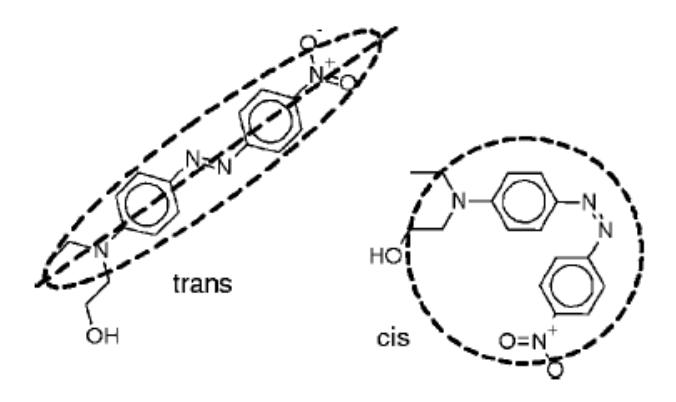
The cis and trans orientational order parameters up to the fourth order are used in the calculations. The fact that the laser used in experiments operates in pulses, rather than continuous wave mode, is also taken into account in this model. The necessary parameters for the model are obtained using both recent experimental results discussed here, and the earlier works on dark polar order relaxation [2, 3]. The model could eventually be used to determine the optimal intensities of poling fields for efficient generation of nonlinear optical structures.