
Quercetin – is a biologically active compound, which is found in many plants, such as a bow, garlic, carrot, whortleberries and other, also in red wine and green tea. It used widely in medicine and pharmaceutics. In particular it is used as a prophylaxis and treatment of oncologic diseases, especially it restrains growth of leukemia. Quercetin, as well as other bioflavonoid, protects the cardiovascular system from harmful influence of cholesterol.
That is why the further researching of this molecule is important. The purpose of this work was an ab initio quantum mechanics calculation of spatial molecular structure of quercetin. These researching of quercetin could explain its multifunctional characteristics, which could enable to estimate its structural factors of biological activity, in particular the presence of strong intramolecular hydrogen bonds (further will use as H-bonds) in all conformers. One of the tasks was to search all permissible conformers and to reveal the most beneficial energy conformers; and ways of their interconversions.
In this work were used Gaussian 03w and AIM2000 application programs that, to our opinion, most adequate to the decision of the put task. Using these packages, we can construct a computer experiment and then define the geometrical structure of, and calculate the intramolecular H-bonds.
Calculations of geometric structure of quercetin were transacted in full optimization conditions. We researched all possible conformers (Fig.1), which obtained from one another conformation by changing torsion angle for 180° round the single bond between phenyl and hetero-rings. Based on these two conformers was also found transition state using QST3 algorithm.
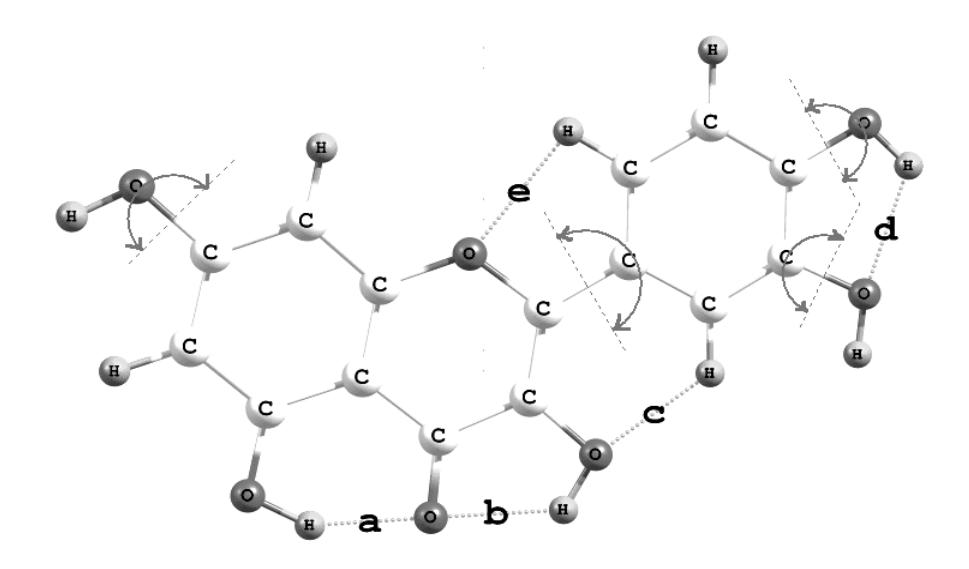
The calculable experiment showed, that the spatial structure of quercetin molecule has 12 mirror symmetrical pairs of conformers, which have a propeller orientation planes of planar hetero- and supple phenyl rings. It is discovered that a molecule of quercetin is a dipole unstable molecule and which geometry depends on a temperature.
The main result is that we found the most energy-efficient conformation, and available in each conformer H-bonds. In addition to the above we can say that almost all conformers have the same number of H-bonds, which energy differ just for 0,1-0,3 kcal/mole, even in transition state some intramolecular H-bonds didn't break. The hydrogen bond energy analysis [1] was performed.
It was found out that some hydrogen connections are not torn, even in the supple form of molecule, which testifies to their durability. Consequently, quercetin has flexible structure. Such plasticity is very comfortable for a liquid environment (namely for formation new molecules): as a molecule has considerable amplitude of oscillation. It means that at a supple form has greater probability of co-operating with other molecules.