
Developments in fiber technologies made fiber lasers and amplifiers capable of providing high output powers, thus allowing these sources to displace conventional lasers in variety of applications. However, high beam powers induce in fiber different nonlinear effects, which reduce overall performance. Highest attainable peak power in fiber amplifier is limited by self-focusing, which arises from intensity dependent refractive index component. When peak power in fiber approaches some critical value ($P_{\text{crit.}}$) self-focusing makes the beam collapse, with intensity becoming high enough for optical damage of fiber to occur. Despite there are many theoretical studies ([1], [2], [3]) investigating beam propagation in fibers at powers approaching $P_{\text{crit.}}$, there is no reliable experimental data approving theoretical calculations. So objective of this work was to investigate experimentally self-focusing in large mode area fiber.
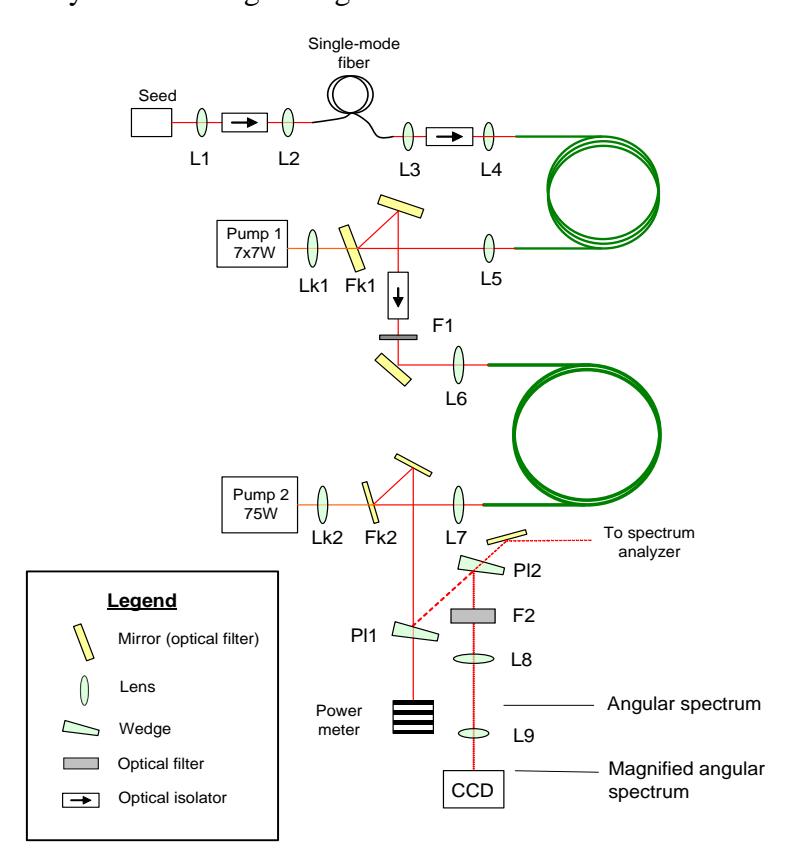
In order to induce self-focusing we amplified 400 ps pulses (generated by passively Q - switched microchip laser, repetition rate - 5 kHz) of 1063 nm light using two fiber amplifier stages (Fig.1). In first amplification stage we used 30 μm core diameter, double-clad, ytterbium doped fiber and in second stage - 65 μm core diameter (effective mode diameter – 50 μm), double-clad, ytterbium doped fiber. We tried to excite fundamental mode in both active fibers. In first stage fiber beam intensity distribution very similar to Gaussian was achieved and in second stage fiber we had some difficulties exciting fundamental mode so beam intensity distribution was not ideal.
We monitored mode diameter changes in last stage fiber using CCD camera set in angular spectrum field. In angular spectrum field mode diameter changes are inversely proportional to fiber mode diameter changes. Our results showed that usually beyond 2 MW peak power optical breakdown occurred in last stage fiber. Highest peak power reached is 2.5 MW. We were able to record possibly self-focusing induced fiber mode diameter decrease (in angular spectrum field mode diameter increased) at peak powers from 1 MW to 2.5 MW (Fig. 2).
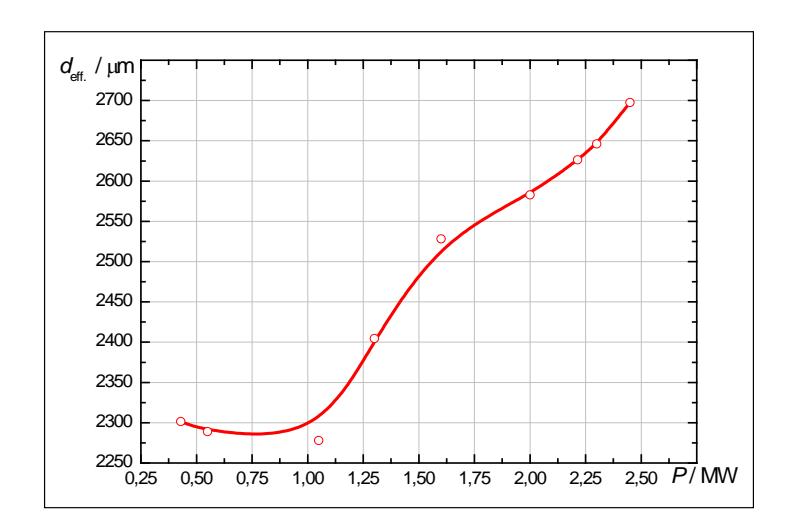
Recorded pulse peak power of optical breakdown is approximately two times smaller than peak power of self-focusing predicted by theory. Most theoretical simulations predict self-focusing critical power for similar fiber configuration of about 4.3 MW ([1], [2], [3]). Some additional research is needed to clarify these results and state real reasons for this.