
In many fields of application ionic liquids are involved as solvents. Important research direction is physical and chemical properties, their assurance of stability and variation identification. Water can significantly change the properties of ionic liquid. Electrical conductivity, solubility, viscosity, polarity can be changed by impurities, especially water [1]. Therefore the exact ionic liquid aqueous solution behavior must be carefully analyzed in order to further broaden the scope of the use of chemicals.
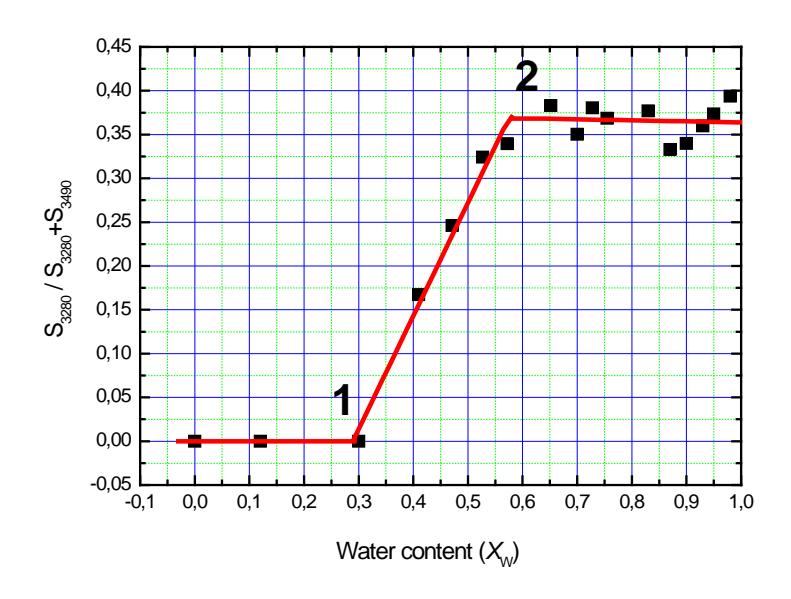
Raman spectroscopy has been used to investigate water role on the structural organization of 1-decyl-3-methylimidazolium bromide and H2O mixtures over wide water concentration range (0 – 98 %) at room temperature. Two-dimensional correlation analysis let us look deeper in water molecules stretching spectral components. Indications of water molecules aggregation in network were obtained during the wide water concentration range (Fig. 1). Break points (1,2) at water concentrations 0,3 and 0,61 let us made a proposal how to explain water molecules organization in ionic liquid [2].