We present results of investigation on Nd:YAG regenerative amplifier (RA) output pulse stretching using different intracavity Fabry-Pérot etalons. Short pulses may lead to self-phase modulation and possible optical damage of active laser medium so it is important to control the pulse duration inside the RA cavity. The relation between pulse duration and its bandwidth is well known:
$$\Delta \nu \cdot \Delta \tau = \text{const} \tag{1}$$
From Eq.1. it is clear that reduction of pulse bandwidth will stretch it in time. Pulse stretching can be accomplished by inserting an etalon in laser cavity. Etalon (also known as Fabry-Pérot etalon) is a transparent material with highly parallel surfaces. When laser beam enters an etalon it works as an optical resonator (Fabry–Pérot interferometer) which transparency changes depending on optical frequency (but is not very periodic according to frequency due to chromatic dispersion). The propagation of rays is depicted in Fig. 1. 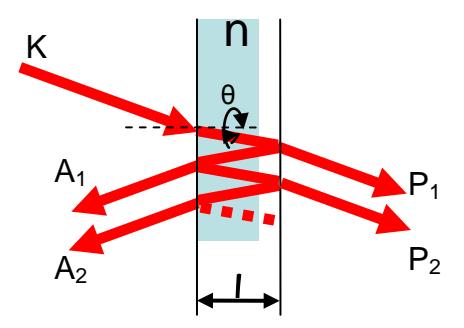
Spectrum narrowing occurs when pulses are propagating through the etalon so the duration of pulses increase. The wavelength separation between adjacent transmission peaks is called the free spectral range of the etalon, $\Delta \lambda$, and is given by [1]:
$$\Delta \lambda = \frac{\lambda_0^2}{2 \cdot n \cdot l \cdot \cos \theta_0} \tag{2}$$
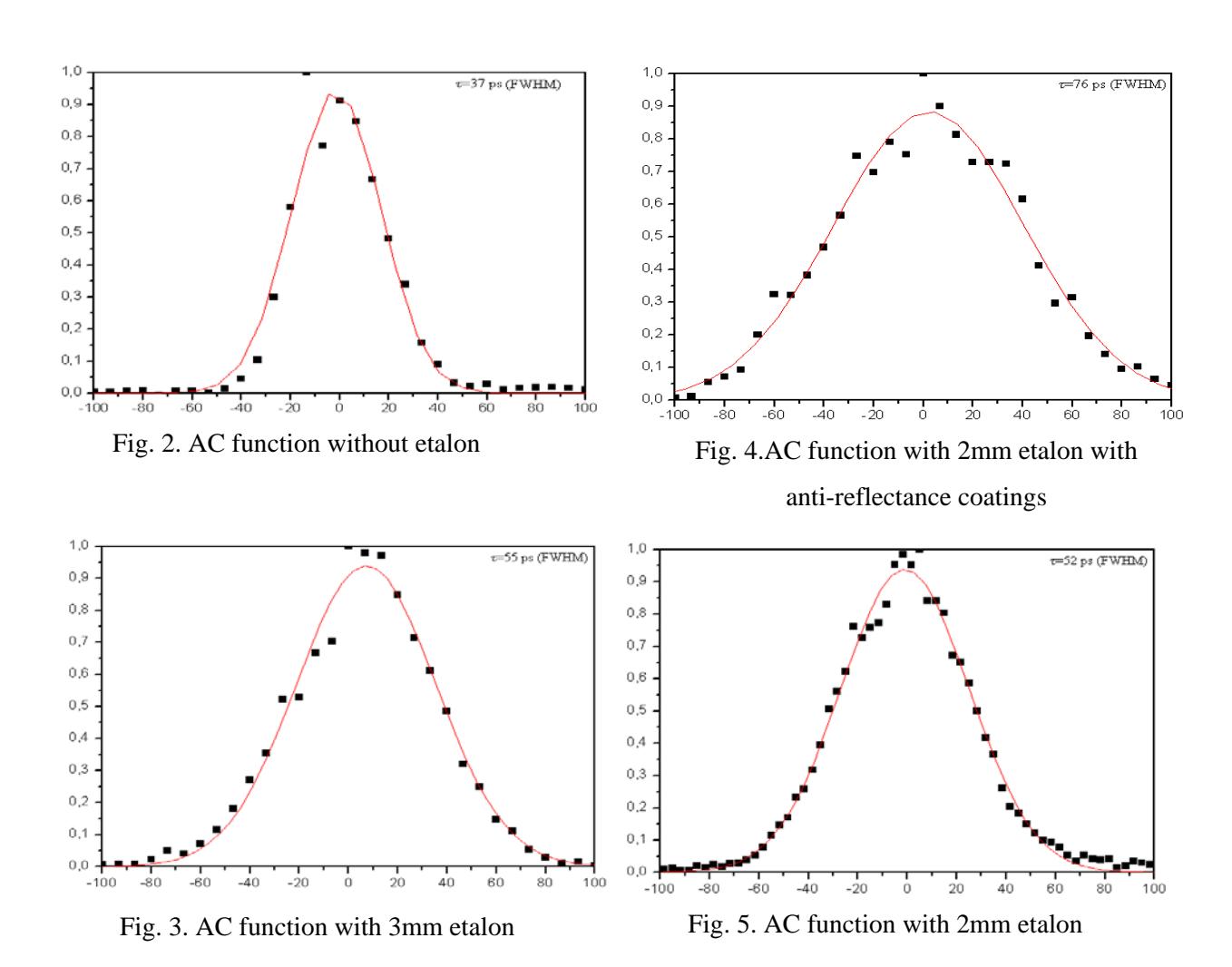
Our goal was to stretch pulses of Nd:YAG RA up to 50 ps. We tested different etalons and measured the output pulse duration using intensity autocorrelation (AC). It is important to know the shape of a pulse, however, the phase still can not be measured using this method [2]. For a Gaussian time profile the autocorrelation width is 1.41 wider than the width of the intensity. This numerical factor, which depends on the shape of the pulse, is sometimes called a deconvolution factor.
Making an assumption that the laser generates Gaussian pulses, the durations of a pulse in different configurations were measured: 26 ps without etalon, 39 ps with 3 mm etalon without coatings, 54 ps using 2 mm etalon with anti-reflection (at 1064 nm) coatings and 37 ps using 2 mm etalon without coatings