
Lately organic disordered materials have drawn increasingly more attention. Cheap production and specific features of organic materials made them suitable for LED and solar panel applications. This is why it is very important to fully investigate the properties of these materials. In this paper, the chosen method of investigation is double injection (DoI) current transient analysis, which enables to measure charge carriers recombination and transport properties within material [1]. Theoretical equations of the charge carriers transport and recombination in general can not be solved, only individual cases can be analysed [2], thus computer simulations are used to obtain results.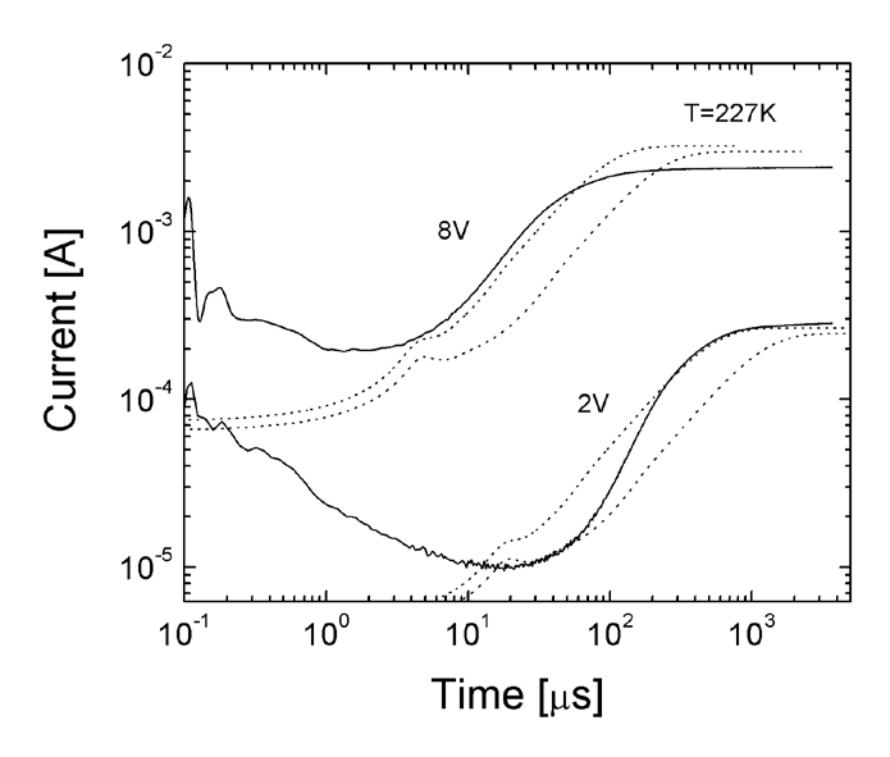
MODELLING OF CHARGE CARRIERS TRANSPORT IN DISORDERED MATERIALS IN THE CASE OF DOUBLE INJECTION
V.Valentinavičius1, N. Nekrašas1, G. Juška1
1 Vilnius University, Faculty of Physics, Department of Solid State Electronics
Fig. 1. Double injection current transients in RR-P3HT/PCBM blend at different voltages compared with the modelled ones.
[1] G. Juška, K. Genevičius, G. Sliaužys, N. Nekrašas, IEEE Journal of Selected Topics in Quantum Electronics, PP, Issue 99, 1-6 (2010).
[2] M.A. Lampert, P. Mark, Current Injection in Solids (New York, Academic Press, 1970).
[3] G. Juška, K. Genevičius, G. Sliaužys, N. Nekrašas, R. Ősterbacka, Journal of Non-Crystalline Solids, 354, Issues 19-25, 2858-2861 (2008).