The phenomenon of multiple filamentation of intense laser beams, whose power exceeds the critical power for self-focusing by many times, is gaining an increasing scientific and technological interest. A significant effort is directed to studies of the multiple filamentation in dense dispersive media, and particularly in transparent solids, foreseeing many technological challenges in parallel material processing, integrated optics, microfabrication and device applications. The most relevant examples outline excitation of coherent multichannel white light radiation, generation of parallel plasma channels, inscription of parallel optical waveguides in transparent media, phase-matched Raman frequency conversion with ultrashort light pulses, and excitation of the arrays of coherent lasing sources. A particularly interesting case of multiple filamentation refers to spontaneous break-up of intense elliptical laser beams, yielding highly reproducible periodic MF patterns, despite being initiated by random intensity modulation [1]. More precisely, the transition from random to deterministic beam break-up owes to multistep degenerate four-wave mixing, and the period of the MF array is controlled solely through the input beam intensity [2]. Despite the fact, that many tools for control and regularization of MF arrays have been elaborated recently, many aspects of their spatiotemporal dynamics in condensed media are still unrevealed. Therefore we study the spatiotemporal dynamics that emerges in the MF regime by self-focusing of femtosecond elliptical laser beams in fused silica by employing three-dimensional mapping technique [3] with high temporal (30 fs) and spatial (5 µm) resolution.
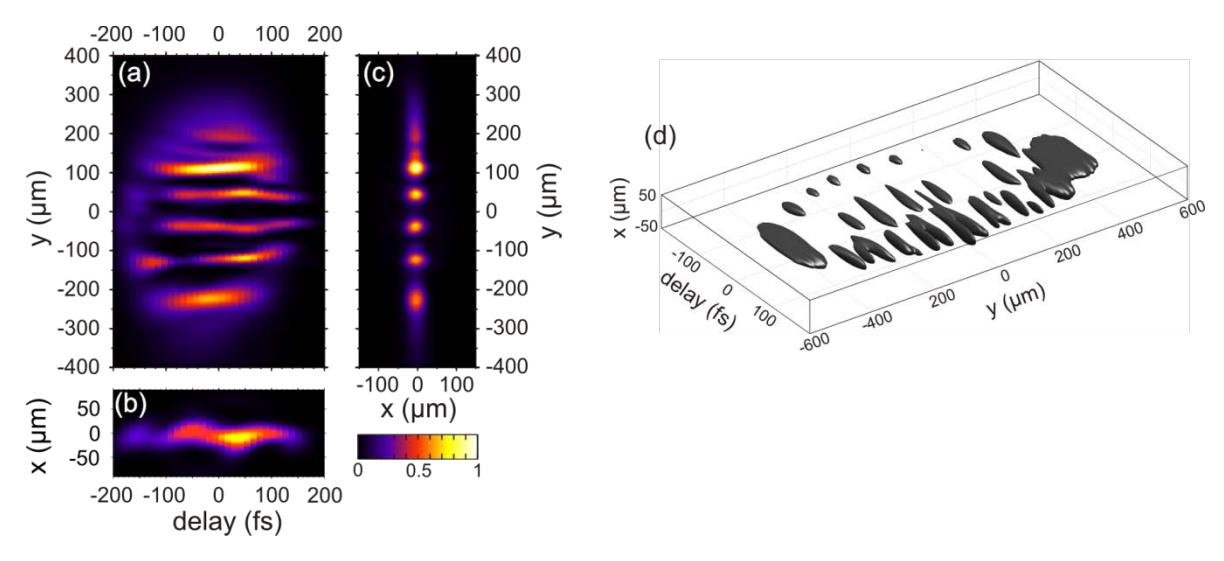
Experimental and numerical investigation revealed a number of interesting features. Although in any case the elliptical input-beams carrying femtosecond light pulses form regular and periodic MF patterns in the spatial domain (with time integration (Fig. 1 (c))) the spatiotemporal behaviour of the individual filaments exhibits surprising differences, depending on the input-beam ellipticity. In the case of moderate input-beam ellipticity, the individual filaments propagate in curved trajectories (Fig. 1 (a), (b)) arising from skewed (spatiotemporal) coherence. The spatiotemporal propagation dynamics is regularized by increasing the input-beam ellipticity, and in part due to permanent modifications of fused silica that occur under intense irradiation. Highly elliptical input-beams
break-up into regular spatiotemporal patterns (Fig. 1 (d)), which undergo strong reshaping that gives rise to occurrence of extremely short (<5 fs), localized peaks at the leading edge, propagating at superluminal velocity. They are followed by the sub-pulses centered on the input-pulse top, and trailed by subluminally propagating pulses with rather complex transverse intensity distribution. Each individual filament is a replica of its neighbour, just with different temporal position of the leading peak, indicating earlier or later pulse break-up event as a function of the local input-beam intensity.