
Laser-Induced Backside Wet Etching (acronym LIBWE) method is a very promising method for micro structuring of transparent materials, for example fused silica, Pyrex, CaF2, BaF2, sapphire and different types of glasses using ultraviolet nanosecond excimer laser pulses [1]. Similarly, to LIBWE with nanosecond laser pulses, the irradiation of the solid/liquid interface of transparent material with femtosecond near infrared (NIR) laser pulses results in etching of the material surface and deposition of decomposition products from liquid [2]. The most important advantages of the LIBWE procedure in contrast with other methods of transparent material micromachining are the relatively low etching threshold fluence, sub μm depth control, quasi smooth etched hole bottoms, and micro-patterns free of micro-cracks and debris [3].
For LIBWE experiments we use AltSCA femtosecond micromachining system (ALTECHNA Co.Ltd., Lithuania), which integrates high precision 3 - axis XYZ sample positioning linear stages (Aerotech, Inc., USA) and Yb:KGW femtosecond laser PHAROS (Light Conversion GmbH, Lithuania). SCA (System Control Application) software was used to compile and execute fabrication algorithms. The synchronization between the high resolution (2,5 nm) positioning system and the laser's firing pattern is precisely (with ±0,3 μm accuracy) controlled with the advanced PSO (Position Synchronized Output). PHAROS laser emits $λ$ = 1030 nm, $τ$ = 300 fs radiation. Pulse repetition rate can be tuned from $f_{\text{min}}$ = 1 kHz to $f_{\text{max}}$ = 350 kHz and average power can be set up to $P$ = 6 W.
Special sample holder was made to guaranty solid/liquid interface condition. We use $f$ = 11 mm aspheric lens (0.25 NA) to focus laser beam to the back side of $h$ = 1 mm thickness borosilicate glass (BK7) (Fig. 1.). 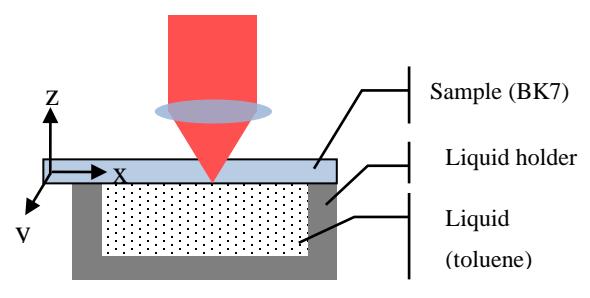
We used toluene (C7H8 or C6H5CH3), also known as methylbenzene or toluol, as "absorbing"-etching liquid. We do not use any absorbers (such as pyrene), which are used for standard LIBWE using nanosecond laser pulses. Toluene is a colorless liquid transparent for $λ$ = 1030 nm irradiation. It can be exited only through multi-photon excitation, so LIBWE using femtosecond laser pulses can be realized only by means of multi-photon absorption.
Without liquid, $h$ = 1 mm thickness BK7 glass front surface measured damage threshold - $Φ_{\text{front}}$ = 1,87 J/cm2, when incident pulse count is less than $P^{\text{D}}$ <100 and back surface – $Φ_{\text{back}}$ = 3,57 J/cm2, then $P^{\text{D}}$ < 1000. If toluene is in contact with sample back surface etching threshold becomes less than $Φ_{\text{LIBWE}}$ = 1,04 J/cm2, for 125 pulses.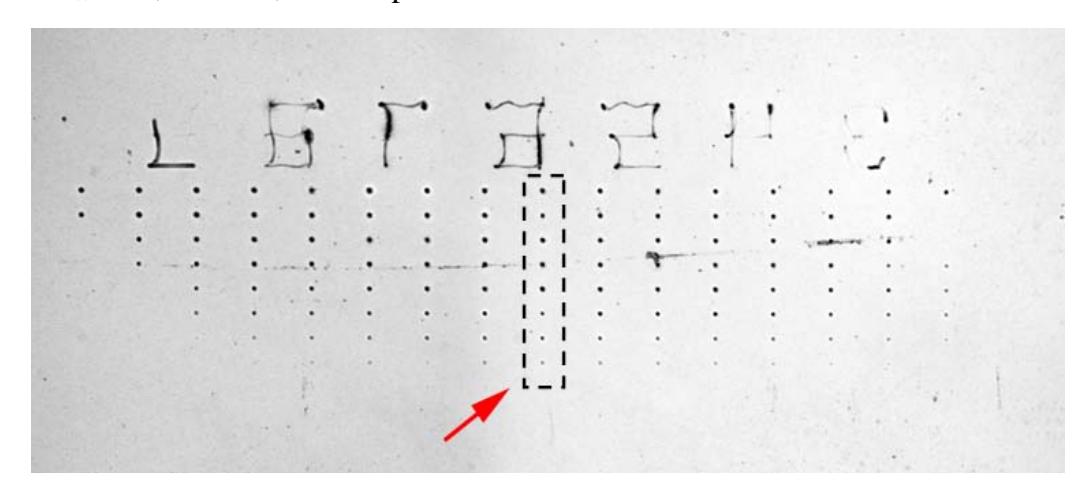
We have demonstrated, that back surface of $h$ = 1 mm thickness BK7 glass "damage" - etching threshold becomes lower, when toluene is applied in contact to back surface. Depth of etched structures varies from 50 nm to 1 μm and can be controlled by changing incident pulse amount or energy.