
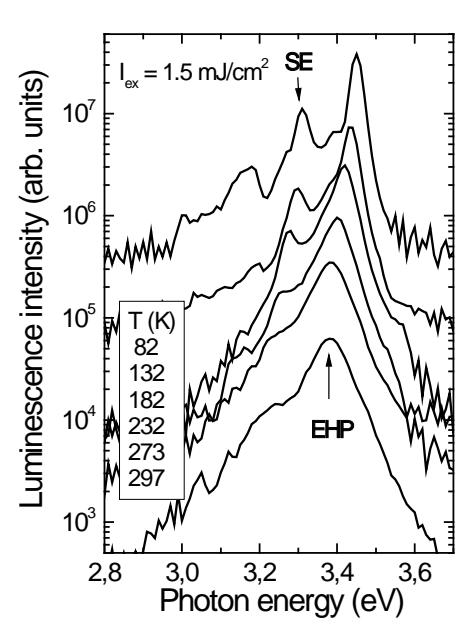
Gallium nitride (GaN) is a wide-band gap semiconductor which is used in the high-frequency electronic and optoelectronic devices due to its superior characteristics (thermal conductivity, breakdown field, thermal/chemical stability, etc.) in the high power/temperature applications. In order to understand the processes in the semiconductor devices under high power/temperature regime one must be aware of the processes in semiconductor layer with high non-equilibrium carrier concentration ($>10^{18}$ cm-3). One of the methods to reach such a high concentration and to characterize semiconductor material is its photoluminescence (PL) measurement under high intensity laser excitation. In this work we present results of PL measurements of GaN sample in 80-300 K temperature range under various layer excitations (0.05-3 mJ/cm2). We show that broad luminescence band peaking at 3.38 eV and dominant at room temperature is due to spontaneous emission of electron-hole plasma (EHP, see Fig. 1), which is common in highly-excited GaN. In order to identify luminescence band with a peak at 3.3 eV at low temperatures time-resolved luminescence measurements were performed which showed that the latter band can be attributed to stimulated emission (SE).
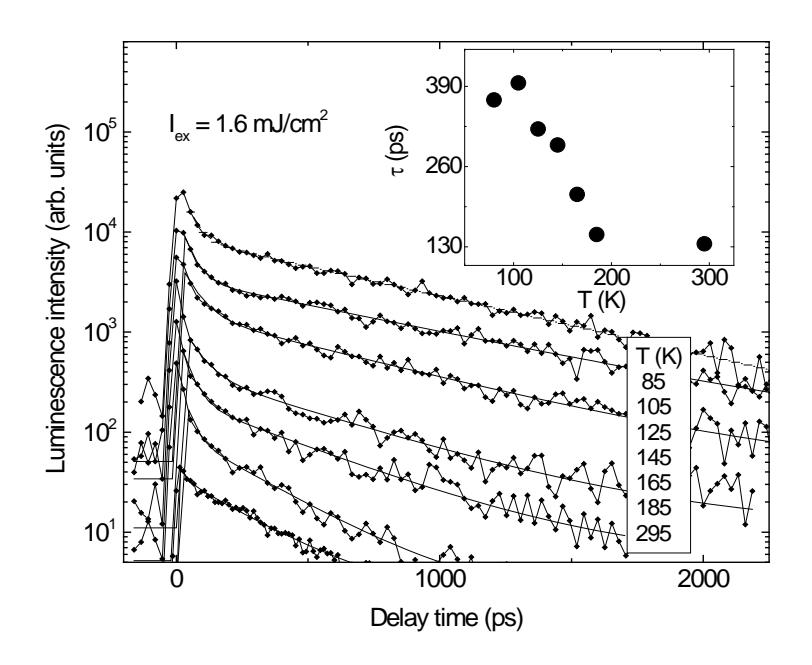
Additionally, non-equilibrium carrier lifetimes were deduced from transient luminescence behavior (Fig. 2). Carrier lifetimes varied from 100 to 400 ps and decreased with increasing temperature (Fig. 2, inset), which is a consequence of a dominant non-radiative carrier recombination mechanism. Linear luminescence decay was observed in GaN layer contrary to speculations about Auger recombination, claimed by some authors to be the main cause of the efficiency droop in the InGaN-GaN based optoelectronic devices [1, 2]. On the other hand, non-linear decay at the early stage of carrier recombination is due to SE mechanism.
Furthermore, by fitting of the high energy side of EHP luminescence band enable us to evaluate carrier temperature and its time dependence by using luminescence spectra at various times after excitation. Estimated maximum plasma's overheat reached nearly 500 K at the first moments after excitation. It was showed that plasma's cooling rate has got fast and slow cooling components. The former is due to emission of LO phonons, which is common in nitrides, while in order to explain the latter other mechanisms of carrier scattering must be taken into account.