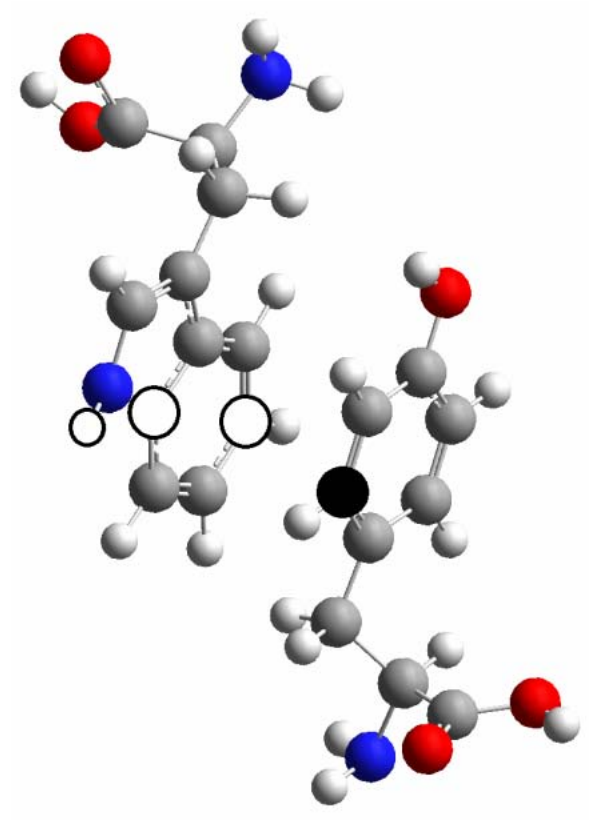
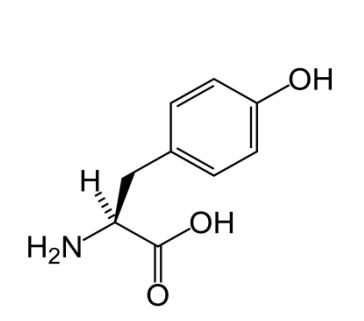
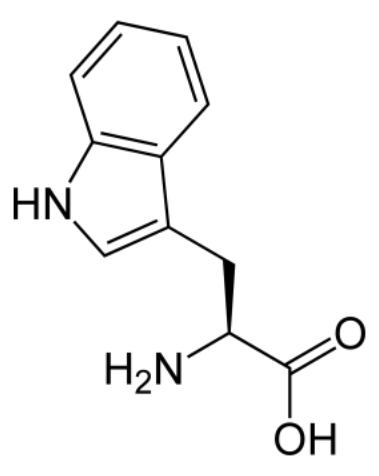
Tyrosine (Fig. 1a) and tryptophan (Fig. 1b) molecules are natural $\pi$-conjugated luminophores. Tyrosine (Tyr) and tryptophan (Trp) molecular pair [1] belongs to class of 20 standard amino acids, which are essential for biological organisms. Electron transfer (ET) processes between proteins and several cofactors are mostly caused by resonance interaction in the [Tyr..Trp] complex. This ET phenomenon is useful for model verifying purposes when donor-acceptor interactions are expressed in empirical, semi-empirical or ab-initio framework.
This work is devoted for modelling of ET processes using advanced quantum chemistry tool GAUSSIAN03 [2] and NUVOLA [3], due to well-known Fermi golden rule [4] and Marcus theory. Total transition rate W evaluation is expressed by following equation:
$$W = \frac{2\pi}{\hbar} \sum_{\alpha,\beta} \left| \left\langle \alpha \middle| \widehat{V}_{\alpha\beta} \middle| \beta \right\rangle \right|^2 (FCWD) \tag{1}$$
where FCWD denotes the Franck-Condon-weighted density of one-article electronic states.
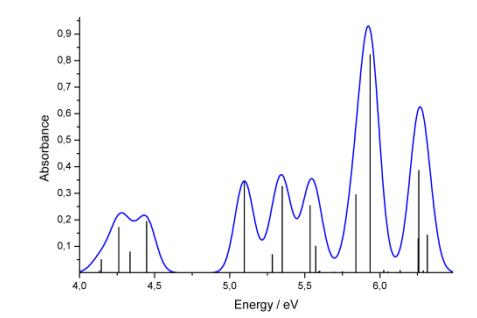
Simulations of optical absorption spectra were done solving simplified form of Schrödinger equation for ZINDO method:
$$\Psi = \Psi_0 + \sum_{ia} T_{ia} \Psi(i \to a) + \sum_{ijab} T_{ijab} \Psi(ij \to ab)\tag{2}$$
Calculations are performed for donor system, Tyr, using several highest occupied molecular orbitals (up to ten) and same number of lowest virtual states. Fig. 2 represents simulated Tyr absorbance spectrum using ZINDO method.
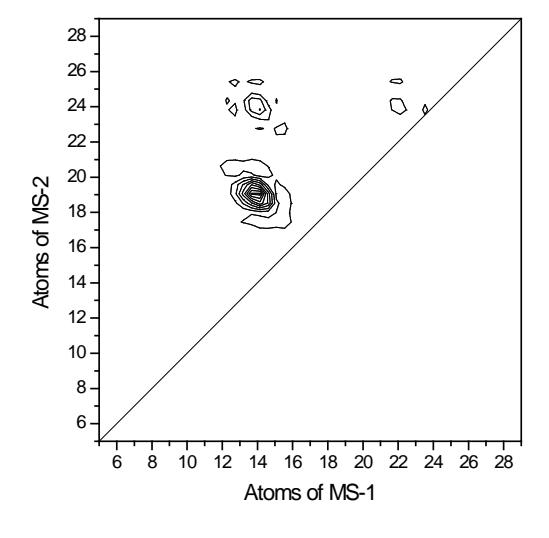
Fig. 3 represents the two-dimensional distribution of intermolecular ET rate on atom position number of two interacting molecules. Essential ET rate occurs between 14 atom (belonging to donor, Tyr) and (19, 24) atom (belonging to acceptor, Trp).