
Iridium-based metal-ligand complexes possessing charge transporting units and featuring high emission efficiency and multi-functionality are promising for phosphorescent organic light emitting diodes (OLEDs). The strong spin–orbit coupling of the transition metal provides a unique possibility for such iridium(III) complexes to overcome the forbidden optical transitions from the triplet states, thus leading to an increase of the internal quantum efficiency of OLEDs up to 100%. Another important feature of transition metal-ligand multifunctional complexes is the charge-transport function, which allows simplification of the OLED fabrication. Since a single layer of the mentioned complexes not only emits light, but also acts as a charge carrier, an additional hole-transport layer in the devices can be omitted. This is extremely helpful in producing OLEDs by cheap spin-casting technique.
A series of multifunctional iridium-phenylbenzothiazole complexes bearing different number (from 0 up to 28) of hole-transporting carbazole groups were synthesized and investigated. In this work triplet emitting complexes were characterized by measuring luminescence spectra, decay lifetimes and quantum yields of their dilute solutions and thin films.
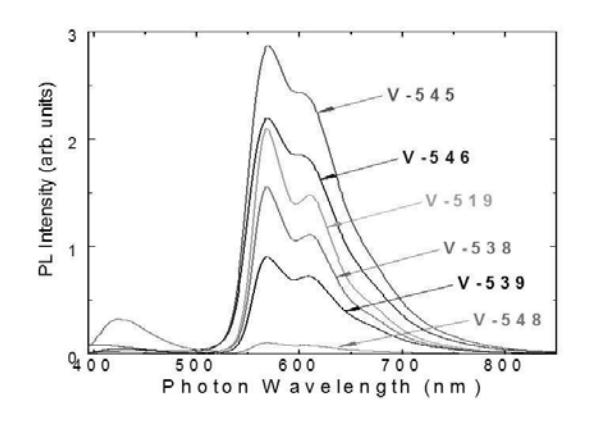
| Number of Carbazole rings | QY (in a solution) | QY (in a thin film) | |
|---|---|---|---|
| V-545 | 0 | 65 % | 2 – 3 % |
| V519 | 8 – lig. | 39 % | |
| V-538 | 12 – lig. | 32 % | 9 – 10 % |
| V-546 | 16 – acac | 50 % | |
| V-539 | 8 – lig. 16 – acac | 19 % | 2 – 2.4 % |
| V-548 | 12 – lig. 16 – acac | 2 % |
Both the solutions and thin films exhibited similar shape of the luminescence spectra. This proved the origin of the light emission to be molecular-like with concentration quenching due to formation of excimers avoided. However, a noticeable difference between the dependence of the quantum yields on the number of the hole transporting groups in the solutions and films has been observed. Solutions of complexes bearing less carbazole groups exhibited higher quantum yields as the ones with more hole-transport groups. In the thin films, thought, the quantum yields did not depend on the number of the carbazole groups. Most likely, the molecules in the films are packed in such way, that the hole transporting groups separate the emitting centres from each other, and thus, prevent emission quenching. Here, the geometry of the molecule plays more important role than the the number of the hole transport groups does. Complexes with the carbazole groups attached to both the ligand and acethylacetonate (acac) group express 5 times smaller quantum yields as those with the hole-transporting groups attached to only one position in the molecule.