Carbon nanotubes (CNTs) are large elongated carbon molecules which can be viewed as a strip cut from an infinite graphene sheet rolled up to form a tube. With a typical diameter of several nanometers but up to centimeters in length, they exhibit an unprecedented length/diameter aspect ratio exceeding 107 and thus are probably the best known example of the quasi-one-dimensional systems [1]. Possessing many amazing properties such as high mechanical strength, high thermal conductivity and tunable electrical properties, CNTs appear ideal for a wide range of current and future applications. On the other hand, many possible properties are still not explored, some of them still lack proper theoretical reasoning. Currently, there is considerable interest in understanding the optical spectra, ultrafast dynamics and related physical mechanisms due to their fundamental importance and direct relevance to many of the potential applications.
Experimental studies of the excitation dynamics in the single-walled carbon nanotubes employing ultrafast pump-probe and time-resolved fluorescence techniques with sub-100 fs time resolution reveal very fast decay kinetics on the time scale of a few hundreds of femtoseconds. As follows from the analysis of the decay behavior of the kinetics and the dependence of the corresponding amplitude on excitation intensity, it was concluded that during the initial part of the kinetics the exciton-exciton annihilation process dominates, while with time, when only one exciton per nanotube is left, the diffusion process becomes predominant [2].
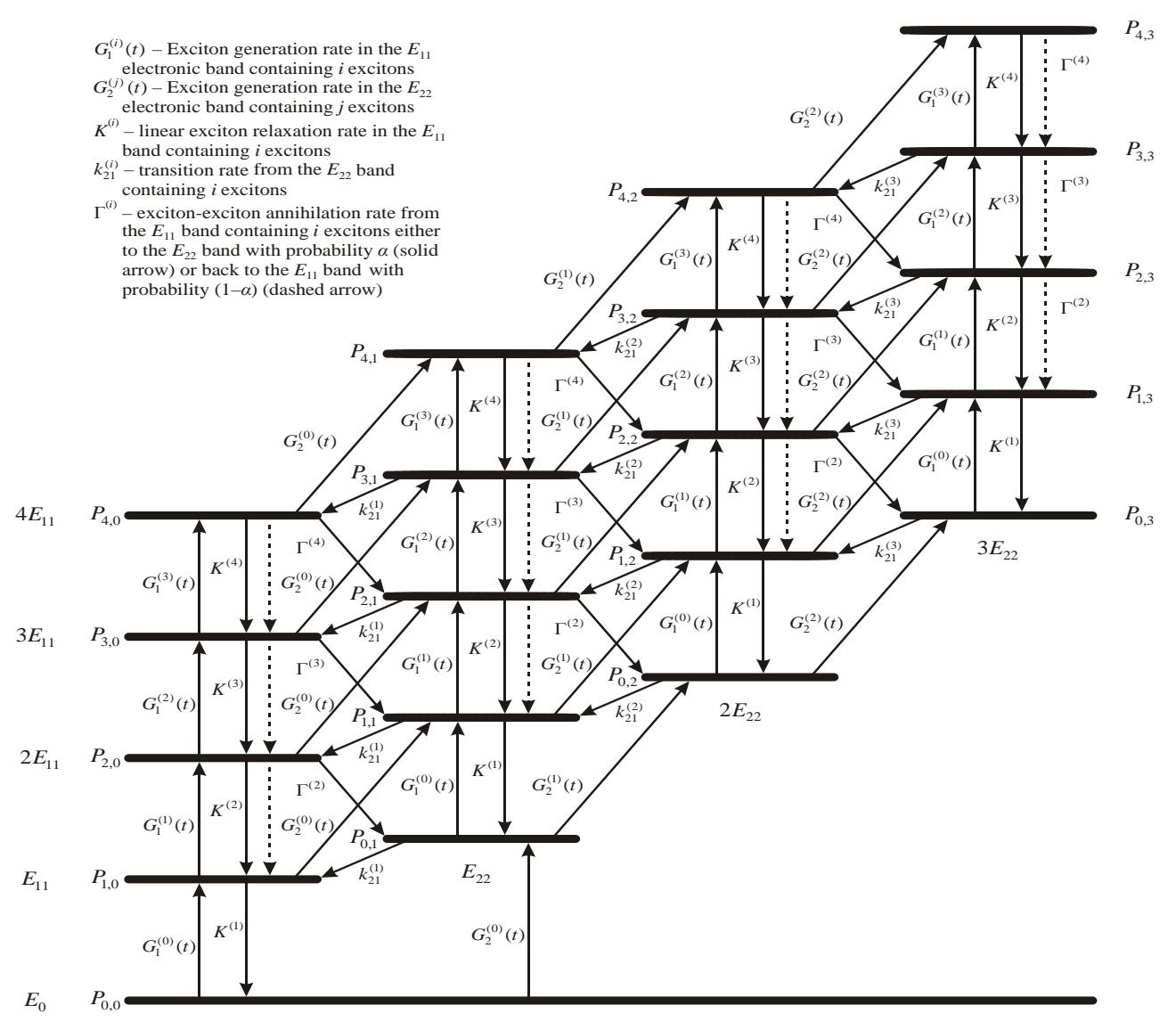
While comparing the mentioned decay kinetics with the existing theoretical models [2], the full agreement is still not achievable. In order to solve this problem and describe the exciton dynamics in CNTs in a more detailed way, a new stochastic model is investigated in this work. In this model, describing the system containing multiple excitons, the only two lower excitonic energy levels ($E_{11}$ and $E_{22}$ respectively) are taken into account with the possible exciton generation/relaxation pathways represented by arrows in Fig. 1. The calculated excitation decay kinetics, obtained by solving the corresponding Master equations for the probabilities $P_{i,j}$, are in better agreement with experimental data for the initial times while there are still some deviations, probably due to the influences of the particular sample preparations and/or surroundings conditions.