
To amplify a very weak signal, we are inevitably confronted with a high-gain low noise amplifiers. It is known that the maximum amplifier noise is influenced by the first amplification stage[1]. Also it is known that then constructing low noise amplifiers, it is better to use field – effect transistors (FETs) rather than bipolar, because FETs have a lower noise factor [3][4].
Thus, it seems that it is enough to buy a low noise FET from a good manufacturer (Toshiba 2SK117GR) and as it is fitted into the circuit, we will have a high - performance low noise amplifier. Unfortunately it is not. Indeed, it is difficult to find the number of transistors with the best parameters. They are not the same. That's where the problem occurs.
To show a solution, I made a low noise amplifier, which has the first stage, consisting of field - effect transistors, with the option to change them without soldering and the second stage – the AD797 operational amplifier. Transistor working point for all transistors was equal.
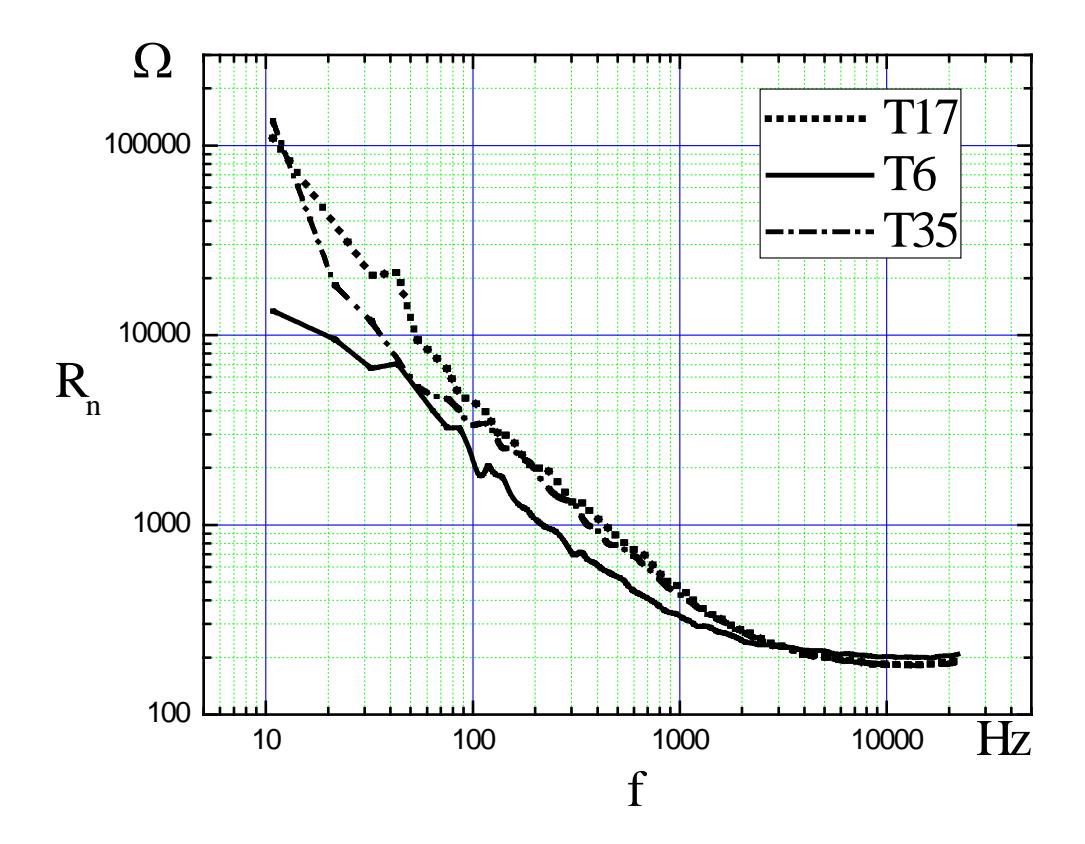
I researched thirty-five 2SK117GR field - effect transistors. To calculate equivalent noise resistance, for each transistor I measured the output signal spectrum, when amplifier input was connected to the ground, and when it was connected to the ground through the 4 KΩ resistor. Noise parameter difference between same marked transistors we see in Fig. 1.
So to make a really good low noise amplifier, it should buy at least a few tens of transistors, analyze them and select the best of them. Connect them into the circuit, then we will get a good quality low noise amplifier.