
Vibrational spectroscopy is very powerful tool to probe the association and interaction of acetonitrile molecules in water and ionic liquids. The structure of acetonitrile - water mixtures has been investigated by Raman and FT-IR spectroscopy methods over wide range of acetonitrile mole fractions (0 % $\le$ $X_{AN}$ $\le$ 100 %, Fig. 1.).
Two dimensional (2D) asynchronous Raman spectra in the region of C≡N vibrations of acetonitrile revealed two peaks which are located at 2252 and 2256 cm-1. Spectral parameters of the C≡N vibration of complexes were studied in H2O-CH3CN mixture.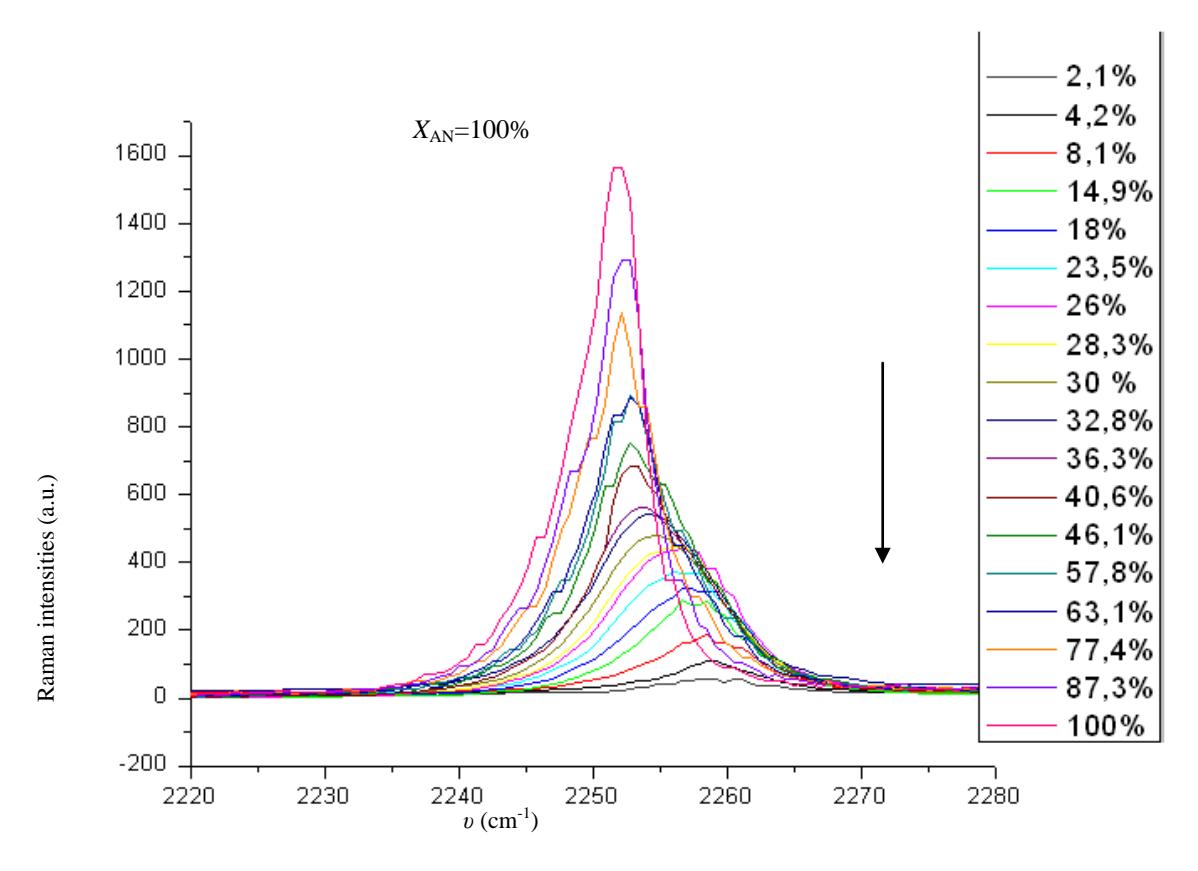
The high-wavenumber part of the band begins to broaden, but the position of the band's maximum in the spectrum is not changed. This broadening can be explained if one supposes that the band consist of more two or more bands. It can be related with formation of acetonitrile clusters in mixture.