DESIGN AND TEST OF TOTAL INTEGRATED SCATTERING APPARATUS FOR OPTICAL COMPONENTS
L. Žitkutė1, V. Sirutkaitis1
1 Vilnius University, Quantum Electronics Department, Saulėtekio al. 9, LT – 10222 Vilnius
Light scattering is one of the factors that limit quality of optical components. Light scattering of optical components has been interesting since 1970 when laser technologies started to grow [1]. Surface roughness, contaminations, micro scratches, fractures, various defects and fluctuations of the density in the bulk reduce quality of the optical components and increase scattering from them [2]. Measurement of light scattering gives opportunity to explore quality of surface faster than other techniques and it allows testing of larger surfaces. A standard procedure according ISO standard 13696 [3] based on total integrated scattering has been developed for this purpose in the characterization of the laser components. Surface roughness in range from 0.1 to 600 nm can be easy extrapolated from total integrated scattering data [4].
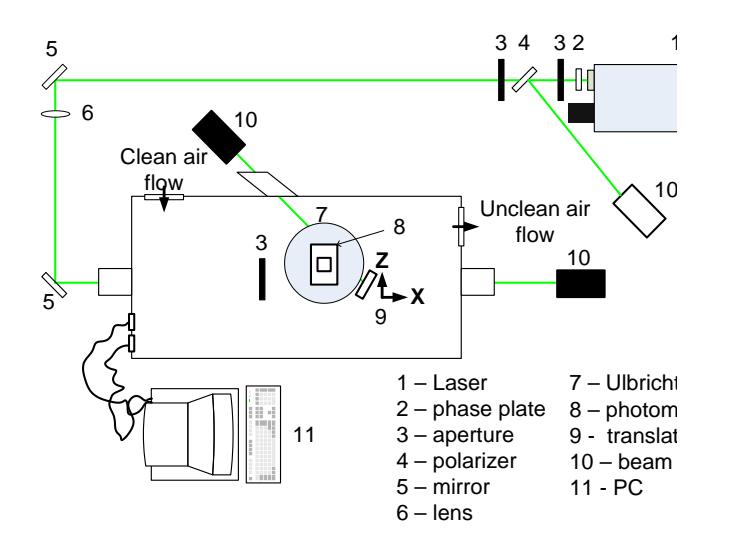
We report design and test of total integrated scattering apparatus based on 1 kHz repetition rate Q-switched laser and capable to perform measurements at 532 and 355 nm wavelengths. Our total scattering measurement facility is equipped with an Ulbricht sphere and designed in way presented on
Fig. 1. Experimental set-up for total integrated scattering measurements
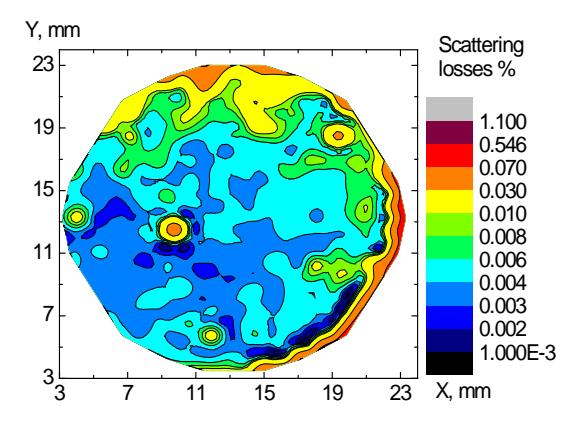
. For the generation of 532 and 355 nm radiation from the laser with fundamental harmonic at 1064 nm are used harmonic generators. The maximum pulse energy at 532 nm is ~0.9 mJ and at 355 nm ~0.6 mJ. For initial pulse energy attenuation by factor up to 100 was used half wavelength plate and thin film polarizer. The laser beam is focused to the ~0.4 mm spot on the investigated sample with 1 m focal lens. The reflected from the sample and transmitted through the sample laser beams are taken away from the specially designed chamber. For the air pollution decreasing in apparatus chamber close loop air cleaning system with Heppa 14 filter was used. It allowed achieve ISO clean class 6 in the chamber and totally avoid particles larger than 5 μm. The chamber additionally lets avoid undesirable light that could influence measurements. The scattered signal was registred by Hamamatsu H5784-20 photomultiplier and proceed by NI data accusation card and computer. Software based on the programming package LabView were created to speed up measurements with minimum human resources. We use calibration routine be insertion of a diffuse reflectance standard with known Lambertian scattering characteristics. To keep the photomultiplier signal at level ~100 mV (much lower than saturation level) in the case of reflectance standard and high scattering samples additional attenuator based on neutral filters was used. It attenuated laser beam by factor in range from 1 to 105. The sample was placed on the two-axis translation stage for the scattering losses measurement of the whole sample. The sensitivity of the facility was determined by measurements of unloaded sphere. For 532-nm beam the sensitivity was better than 10-4 % or 1 ppm and was caused by Rayleight scattering in air and by scattering on small (<1 μm) particles. The possibilities of the developed scattering apparatus in scattering losses measurements of the whole surface are presented in
Fig. 2. Map of scattering losses for e-beam coated fused silica substrate
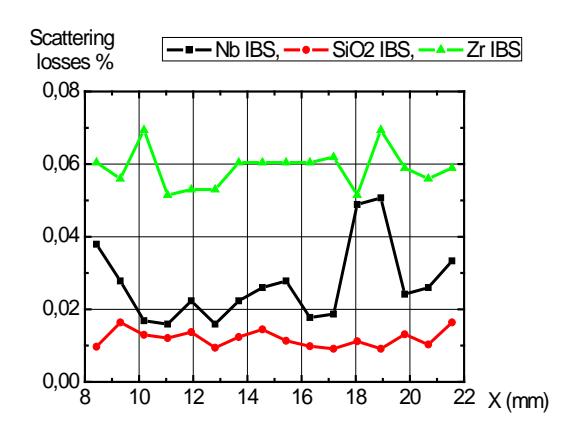
and on comparison of the scattering losses of the different coating materials coated on fused silica by IBS method is presented in
Fig. 3. Scattering losses for three different samples coated by IBS method
.
[1] Stover, J.C., Optical Scattering: Measurement and Analysis. 2 ed, ed. P.M. Series. (Bellingham, Washington, USA: S P I E-International Society for Optical Engineering. 340, 1995)
[2] Hou, H., et al., Appl. Opt., 44(29): p. 6163-6166 (2005)
[3] Standardization, I.O.f., International Standard ISO 13696, Optics and optical instruments - Test methods for radiation scattered by optical components. 2002: Geneva, Switzerland. p. 26.
[4] Bennett, J.M. and L. Mattsson, Introduction to surface roughness and scattering. (Washington, D.C.: Optical Society of America. 130 1999,).