
Pulse duration is one of the main characteristics of coherent laser radiation, however it has always been a difficult parameter to evaluate since standard electronic detectors are not capable of measuring processes on shorter than sub-nanosecond time scale. That is why it is necessary to use methods that are able to measure events as short as a few optical cycles. Also most measurement devices include nonlinear optical elements.
The intensity autocorrelation (AC) was one of the first attempts to measure sub-nanosecond pulse duration. In our work we used second-order AC. This method involves splitting the pulse into two of equal intensity, variably delaying one pulse with respect to the other, and spatially overlapping the two pulses in some directly responding nonlinear-optical medium (Fig. 1.).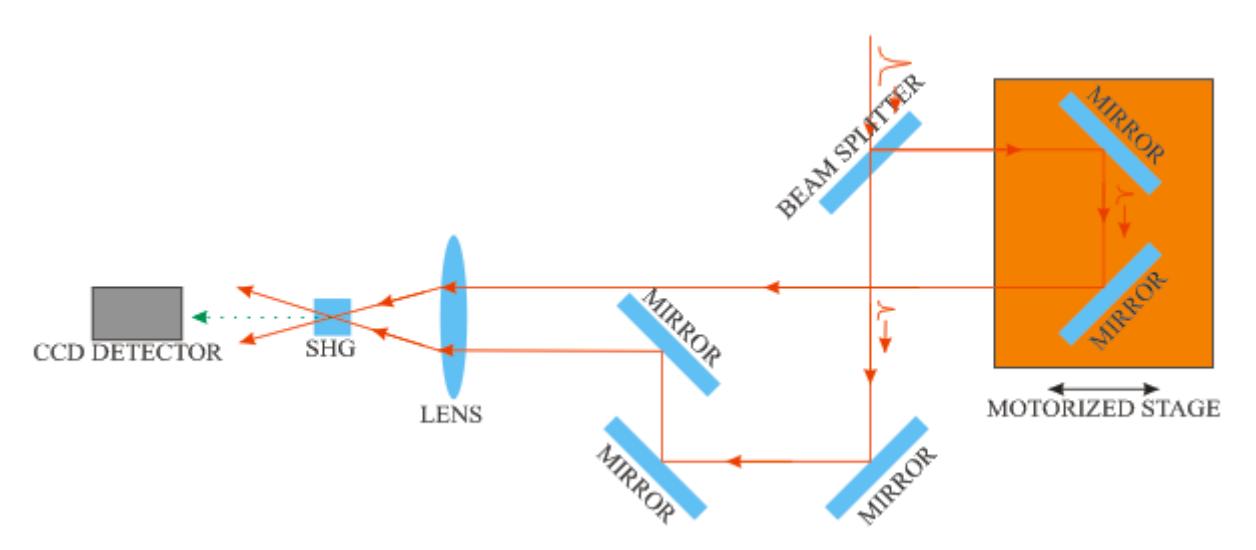
A second - harmonic crystal will radiate “signal light" at twice the frequency of input light with a field envelope that is given by: $$E_{sig}^{SH}(t, \tau) \sim E(t)E(t-\tau)\tag{1}$$ where $\tau$ is the delay. This field has an intensity that is proportional to the product of the intensities of two input pulses: $$I_{sig}^{SH}(t, \tau) \sim I(t)I(t-\tau)\tag{2}$$ Detectors are too slow to resolve this beam in time so they will measure: $$A^{2}(\tau) = \int_{-\infty}^{\infty} I(t)I(t-\tau)dt\tag{3}$$ This is the intensity autocorrelation. The superscript (2) Eq. 3 implies that it is a second order autocorrelation. Here we assume that our pulse profile is Gaussian. For a Gaussian time profile, the autocorrelation width is $\sqrt{2}$ wider than the width of the intensity.
In this work we set a goal to make this measurement precise and fast. We did this by adding motorized stage (delay line) and implementing a program that moves delay line and collects data from photo-diodes. This program was written using "LabVIEW 8.0". It also allows saving and opening data and calculates the duration of a pulse.
The drawbacks of this method are: 1. Minimum and maximum value of pulse duration that can be measured with this method depends on delay line parameters. Short motor step allows to measure very short pulses and long motorized stage – long pulses 2. Speed depends on data acquisition card and motor speed; 3. Requires relatively high peak power in order to generate second harmonic.
Picosecond pulses duration was measured using second order intensity AC and the experiment was automated using delay line with servo engine and LabVIEW to control it. This method was used to characterize pulse stretching using intracavity Fabry-Pérot etalon.