
Lighting sources, which are based on additive colour mixing of emissions from several light emitting diodes (LEDs), offer versatility in colour quality of illumination Tetrachromatic (red-amber-green-blue) solid-state lamps with a particular correlated colour temperature can be optimized in respect of colour rendering index (CRI), luminous efficiency of radiation (LER), colour fidelity index (CFI) and colour saturation index (CSI) [1]. The possibility in varying the spectral power distribution (SPD) of the lamp allows illumination with a trade-off between fidelity and saturation of object colours (Figure 1).
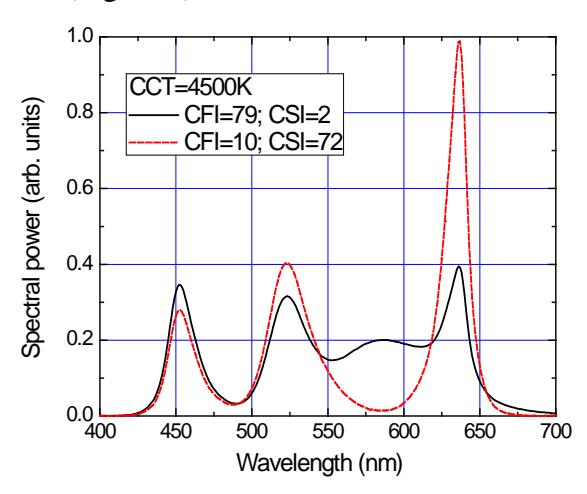
A white solid state lamp with variable SPD was assembled of Philips Lumileds Lighting Luxeon® Rebel royal-blue 452 nm and green 523 nm InGaN LEDs, phosphor converted amber 589 nm LEDs, and red AlGaInP 637 nm LEDs. A computer-controlled electronic circuit for the variation of the partial fluxes of each group of LEDs was developed using the principle of pulse width modulation. To mitigate the temperature drifts of the LED output due to the heating of the chips, a feedback was introduced into the driving circuit. Uniform distribution of the colour-mixed emission was provided by means of plastic colour mixers. The developed "smart" solid-state lamp can find numerous applications in lighting where individual needs in colour quality are to be met.