OPTICAL AND ELECTRICAL NOISE CHARACTERISTICS OF FABRY - PEROT LASER DIODES
Ignas Stasevičius1
1 Vilnius University, Physics faculty, Radiophysics department
Laser diodes represent a key element in the emerging field of optoelectronics which includes, for example, optical communication, optical sensors or optical disc systems. For all these applications, information is either transmitted, stored or read out. The performance of these systems depends to a great deal on the performance of the laser diode with regard to its modulation and noise characteristics [1]. Infrared multimode Fabry – Perot laser diodes are employed as light source in short – haul optical communication systems, where stable narrow radiation spectrum under variable ambience conditions is desired.The goal of this project is investigation of the impact of low - frequency to certain characteristics of Fabry - Perot laser diodes. Low frequency noise is usually vivid below the margin of 20 kHz depending on the material and its investigations are inevitable part of determining the quality of laser structures and likely reliability. The noise spectrum is $1/f$ type and noise is caused by various growth and processing defects [2].
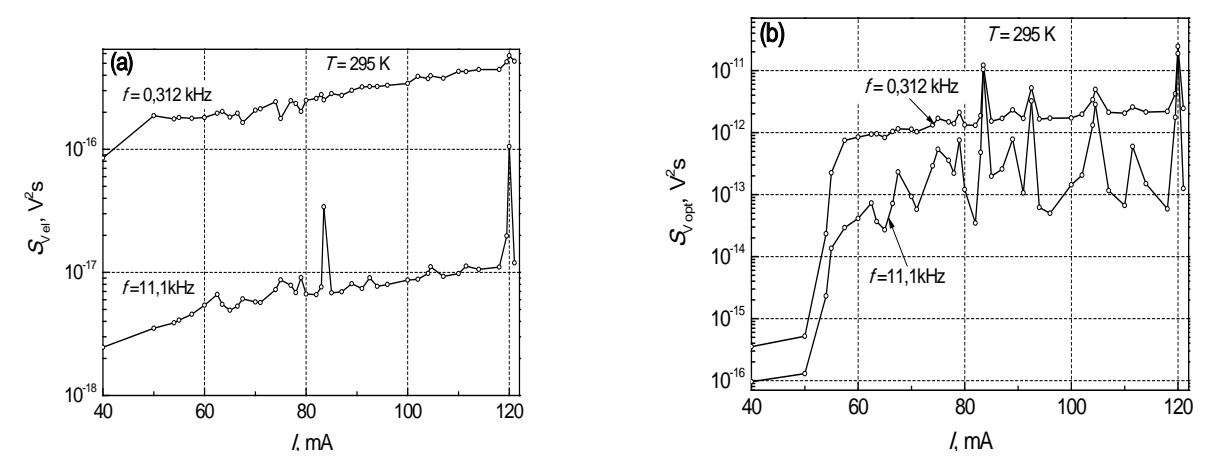
Fig. 1. Laser diode electrical (a) and optical (b) noise spectral density (0,312 kHz and 11,1 kHz) from the reference over injection current in laser diode.
The probing of laser diode is performed in a shielded space so that measurement would not be affected by external noise. The voltage fluctuations, or electrical noise, and radiation power fluctuations, or optical noise, are the characteristics of laser diode measured simultaneously during the process. Investigation of electrical and optical noise is made by noise analysis program which receives the data through computer sound card.Optical noise grows rapidly whenever threshold current is reached. This increase is due the instability of lasing-mode operation – in the active layer spontaneous emission is randomly changed with stimulated emission, the number of free carriers and emitted photons is fluctuating.As the injected current is enhanced, the growth of optical and electrical noise spectral density is observed. Whenever specific values of current are present, the growth of electrical and optical noise is abrupt and vivid. After investigation of optical spectra it was determined that as these values are present the generating modes set is changed, the spectrum is composed of not one, but several modes sets that randomly change. The fluctuations of light intensity evoked by the generation of random modes are called mode hopping noise [3]. During these mode leaps the spectral density of electrical and optical noise grow rapidly and their form is more analogous to the one of white noise rather than $1/f$ noise. What is more, during this effect the noise spectrum is composed of higher frequency components. The main reason of mode hopping effect is that of carriers recombination in barriers and in the cladding layer [4].The correlation factor between electrical and optical noise spectral densities is positive but close to zero as long as current is below the threshold value. During mode hopping effect, correlation factor grows abruptly.The effect of mode hopping and its range depend on the temperature, after research it was identified that higher temperature evokes the mode hopping effect with a lower current. Higher temperature and higher injected current lead to the increase of wavelength of generated modes. However, higher temperature also leads to lower correlation factor between electrical and optical noise. The reason of the shift of wavelengths is due to the change of laser voltage, temperature and quantum well population which evokes the shift of laser energy levels [4].
[1] K. Petermann, Laser diode modulation and noise (Kluwer Academic Publishers, the Netherlands, 1991).
[2] R. Sobiestianskas, J. Simmons, S. Smetona, J. Evans, S. Pralgauskaitė, J. Matukas, V. Palenskis, Optical and electrical noise of ridge waveguide InGaAsP/InP F-P and DFB MQW lasers, 16th International Conference ICNF 2001: Noise in Physical Systems and $1/f$ fluctuations. Gainesville, Florida, USA, 22-25 October, 2001.
[3] K V. Palenskis, J. Matukas, S. Pralgauskaitė. Laser diodes (Vilnius, 2000).
[4] S. Pralgauskaitė. Optical and Electrical Low-Frequency Noise Characteristics of Multimode and Singlemode InGaAsP/InP Multiple-Quantum Well Laser Diodes: Doctoral dissertation. Vilnius, p.110, (2003).