
Indium oxide doped with tin oxide (ITO) is used to make transparent conductive coatings. Typical applications of such ITO-coated substrates include touch panel contacts, electrodes for LCD and electrochromic displays, energy conserving architectural windows, defogging aircraft and automobile windows. The deposited film layer must contain a high density of charge carriers for it to conduct. These carriers are free electron and oxygen vacancies, and an excessive population produces absorption. High conductivity is balanced against high transmission in the visible region. To obtain transmission near 90%, sheet resistance must be > 100Ω/sq. Due to the fragility and lack of flexibility of ITO layers, and the costly layer deposition requiring vacuum, alternatives for ITO coatings are being sought. Indium-doped zync oxide (IZO) coatings are a prospective replacement. For particular technical demands it is important to know such parameters as transmission, reflectance and absorption of such coatings.
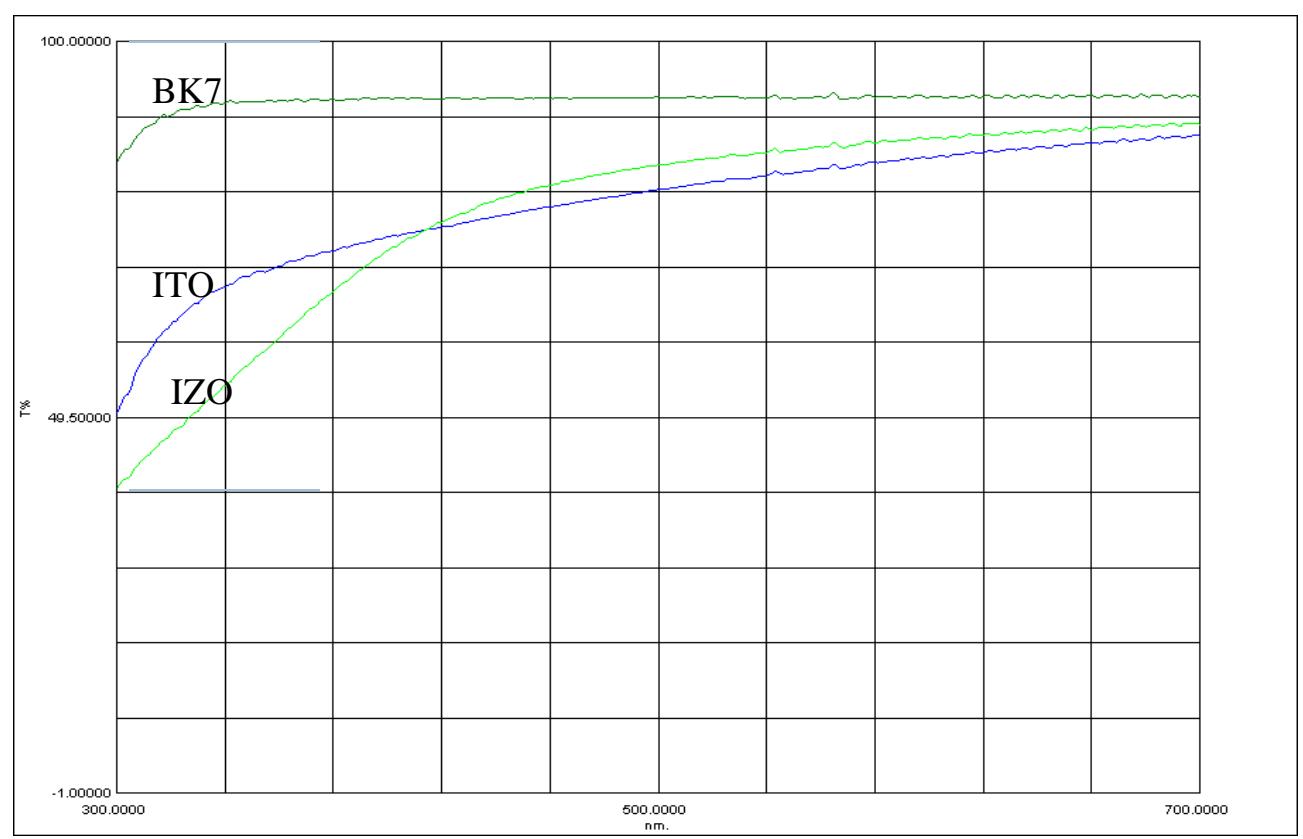
Transmission of ITO and IZO coatings deposited on 15×15×2 mm BK7 glass plates, and BK7 glass plate without any coating was measured by spectrophotometer in this experiment (Fig.1).
Absorption of the same samples was measured with laser calorimetric system. Absorption measurement was performed using NL220 nanosecond ND:YAG laser's second and third harmonics, 532 and 355 nm respectively. Pulse duration was ~10 ns, repetition rate – 1 kHz. Power of 532 and 355 nm radiation was 380 and 200 mW, respectively. Absorption results (Table 1) were analyzed by three methods, two of them (impulse and gradient methods) are standardized in ISO/DIS 11551 (International Organization for Standardization).
| Material | Exponential method | Gradient method | Pulse method |
|---|---|---|---|
| α, % | α, % | α, % | |
| BK7 (532nm) | 0.0675 | 0.058 | 0.0713 |
| BK7 (355nm) | 0.186 | 1.15 | 1.6 |
| ITO (532nm) | 0.1933 | 0.201 | 0.268 |
| ITO (355nm) | 1.2 | 1.15 | 1.6 |
| IZO (532nm) | 0.147 | 0.163 | 0.208 |
| IZO (355nm) | 9.29 | 8.73 | 12.97 |
Results show that transmission of IZO and ITO coatings decreases when wavelength becomes shorter. Absorption of ITO and IZO coatings especially increases for 355 irradiance which could become a significant restrictive factor for many applications.