Combining cobalt ferrite (CoFe2O4) which has cubic spinel structure with perovskite-type stuctrure BaTiO3 leads to multiferroic behaviour of the material. CoFe2O4-BaTiO3 is a multiferroic material, which means that it exhibits more than one order parameter in a single phase. In this case we have magnetic and ferroectric order parameter coupling. This type of materials are uncommon, even though the interconversion mechanisms of energies stored in magnetic and electric fields plays an important role in many devices such as transducers, storage devices, etc. The investigated sample was synthesized during the sol-gel process. Already performed experiments showed that dielectric properties strongly depend on the fabrication mechanisms of sample as in one sample irreversible structure changes after heating was observed and in the other not.
Measurements of dielectric properties of CoFe2O4-BaTiO3 ceramics were made in the frequency ranging from 20 Hz to 150 MHz and temperature ranging from 120 K to 450 K. The temperature dependence of the real part of complex permittivity $\varepsilon^*=\varepsilon'-i\varepsilon''$ showed that there is only one phase transition at a Curie temperature around 300 K.
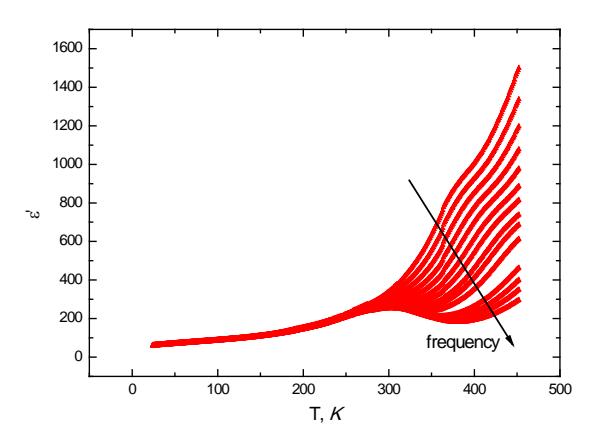
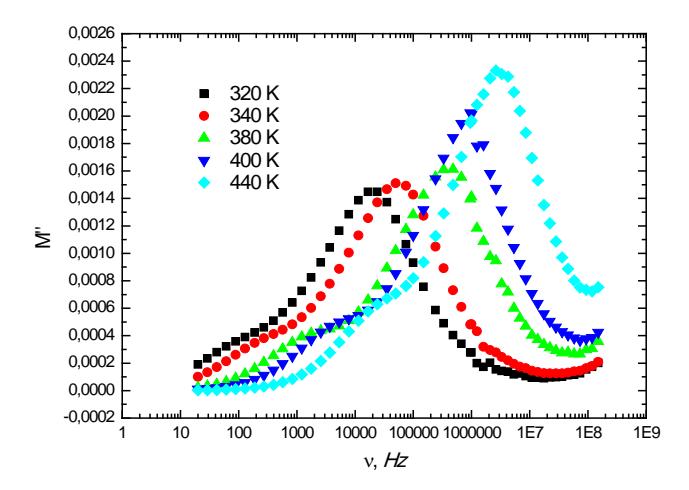
Fig.1. shows that at high temperatures the growth of dielectric permittivity is caused by electric conductivity. Accordingly, the complex electric modulus, which is inversely proportional to complex dielectric permittivity $M^*=1/\varepsilon^*$, of CoFe2O4-BaTiO3 was calculated. The resulting dependencies on frequency are shown in fig. 2.
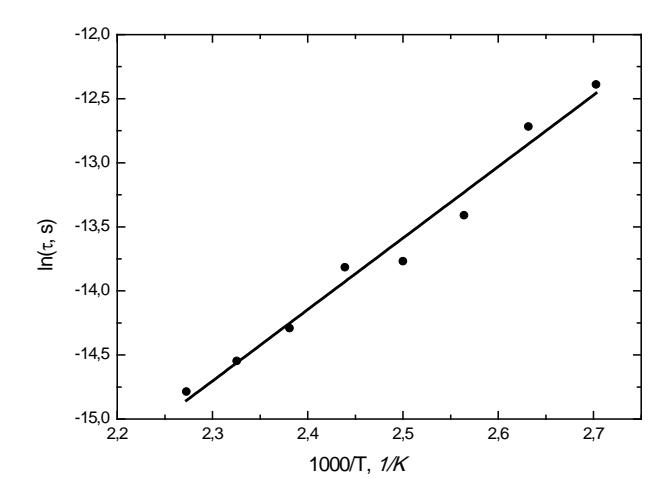
In fig. 3 the change of peak positions of imaginary part of complex electric modulus depending on the inverse temperature are shown. Linear regression coefficient of these points corresponds to activation energy $E_a$, which in this case is $\frac{E_a}{k_b} = 5578$ K.