
BiSBr and BiSeBr are semiconductors which belong to the group of V-VI-VII compounds. This type crystals own several interesting physical properties, such as high photoconductivity, ferroelectricity, electrooptical effect, electromechanical effect, piezoelectricity, and a large temperature dependence of the band gap [1-4].
The structure of these crystals in the paraelectric phase is orthorhombic, with $D_{2h}^{16}$ space group containing four molecules per unit cell. The crystals consist of double chains of atoms. All atoms in these crystals lie on mirror planes normal to the $c$ – axis. In the double chains a short and strong Bi-S or Bi-Se bonds take place. Weak Van der Waals type bonding links these double chains.
Electronic structure and optical properties of BiSBr and BiSeBr crystals were investigated by the full potential linearized augmented plane wave (FL-LAPW) method with density functional theory (DFT) using Wien2k [5] package. The lattice constants and positions of the atoms in the unit cell were taken from [3, 4]. The calculation was performed with $Rk_{max}=7$ ($R$ is the radius of the smallest muffin-tin sphere and $k_{max}$ is the cut off the plane wave) for the convergence parameter for which the calculation stabilize and convergence in terms of the energy are achieved. The values of the muffin-tin radii $R_{MT}=2.94$ for Bi, $R_{MT}=1.90$ for S, $R_{MT}=2.02$ for Se and $R_{MT}=1.96$ for Br. A mesh of 14 x 29 x 11 k-points in the irreducible part of the Brillouin zone was used. The iteration halted when the difference in the eigen values was less than 0.0001 between steps of convergence criterion. The separation of valence and core states was chosen as -6 Ry.
The dielectric functions $Im\varepsilon$, $Re\varepsilon$ calculated with DFT in the wide range of the energy are shown in 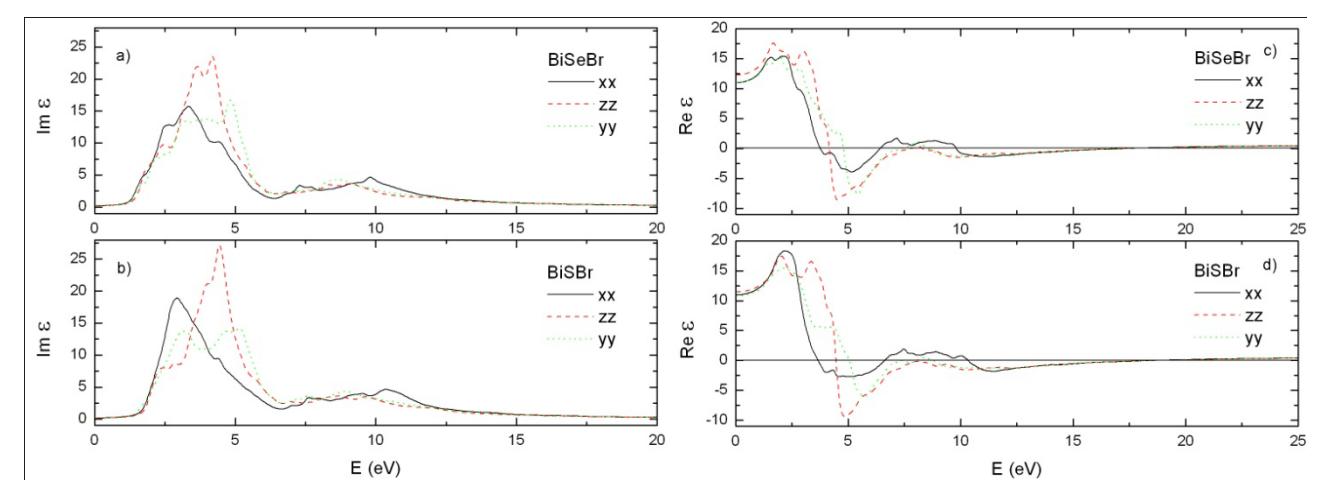
At intermediate energies (1 to 25 eV) the energy losses are due primary to a complicated mixture of single electron excitations and collective excitations (plazmons). Plasmon losses correspond to a collective oscillation of the valence electrons and their energy is related to the density of valence electrons. The energy that of the maximum peak of $Im[-\varepsilon^{-1}(E)]$ is assigned to the energy of volume plasmon $\hbar\omega_p$. At this energy, the real part of the dielectric function $Re\varepsilon$ coming from the high frequency side goes through zero. The maximum peak of $Im[-\varepsilon^{-1}(E)]$ is located at energy of 20 eV for BiSBr and at energy of 18.8 eV for BiSeBr. Dielectric function $Re\varepsilon$ changes sign (vanishes) at the same energy.