PLASTIC DEFORMATION EFFICIENCY EVALUATION OF MULTILAYER BAR UNDER AXIAL LOAD
J. Tilindis1, V. Kleiza2
1 Kaunas University of Technology, Faculty of Technology, Department of Mechanical technology, Daukanto 12, LT-35209 Panevežys, Lithuania
2 Kaunas University of Technology, Faculty of Technology, Department of Physical Sciences, Klaipedos 1, LT-35212 Panevežys, Lithuania
Multilayer structural elements (MSE) are used in various mechanical structures because they enable to combine different materials, thus reaching the required mechanical properties. Most of the MSE calculation methods calculate the state of loaded MSE, only within elasticity limits. While in
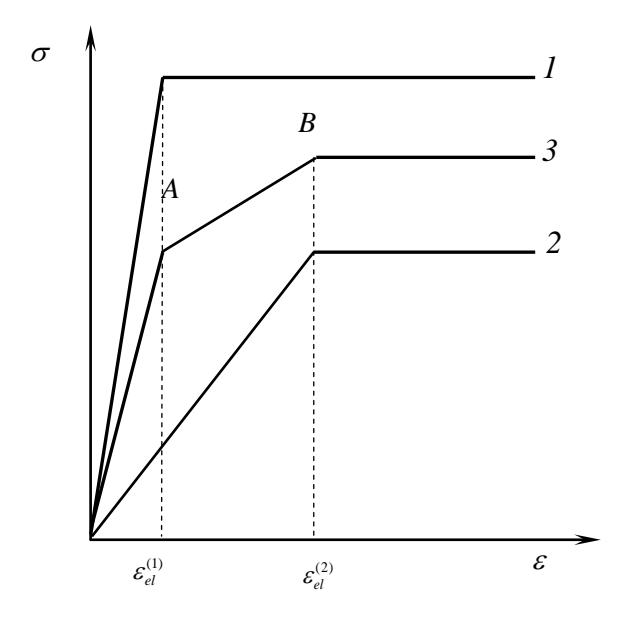
Fig. 1. Schematized stress-strain diagrams of a stretchable two layer bar comopsed of ideally elasto-plastic materials. 1,2 are the stress-strain diagrams of materials that compose a bar, 3 is that of a multilayer bar.
some mechanical structures slight plastic deformation could be allowed, in the MSE this deformation could be permissible as well. When the load increases up to level that in one or even more MSE layers plastic deformations arise, the layers in the elasticity zone, take over a part of the bigger load. The ratio between the increased load with the limiting load, which is calculated in
deforming a body within the limits of elasticity, determines the plastic deformation effectiveness. In paper [2], this effectiveness was calculated by studying the two layer bar. The stress-strain diagrams of two layer bar composed of ideally elasto-plastic materials presented in Fig. 1.
It is known [1] that, in extended bars made of the same material, the limiting loads and the coefficient of plastic deformation in the case of elastic-plastic deformation depend on the fastening conditions of the bars, the structure of the bar system, and other factors. In [2], the effect of different factors on the strength and rigidity of multilayer bars under elastic deformation is investigated.
The authors have proposed here the method for calculating stretchable multilayer bar limiting loads, obtained under ideally elasto-plastic deformation, calculation method and analysis of effectiveness coefficient of the bar depending on materials, of which it is composed: elasticity module, stress that causes material plasticity, and on the variation of cross-section areas occupied by these materials.
Mathematical expressions have been proved by means of which it is very simple to calculate the values of the coefficient with arbitrary values of cross-section areas.
So final equation was determined:
$$m = \frac{N_{Kpl}}{N_{Kel}} \tag{1}$$
where $m$ – coefficient, $N_{Kpl}$ – limiting plastic load, $N_{Kel}$ – limiting elastic load. These variables depend on properties of each material composing bar: elasticity module $E_i$, stress $\sigma_i$, and cross-section $A_i$, and $i$ – number of materials used in the bar [3].
[1] J. Bareisis, D. Garuckas, Mechanika, Vol. 24 No. 4, 23-30 (2000).
[2] J. Bareišis, V. Kleiza, Mechanics of Composite Materials, Vol. 40 No. 2, 135-144 (2004).
[3] J. Bareišis, V. Kleiza, Multilayer Bars Evaluation, under elastic and elasto-plastic deformation, Proceedings of International Conference Mechanika-2001. Kaunas, 2001, p. 254-259.