
Particulate air pollution plays important role in the atmospheric radiation balance and can influence global and regional climate. Moreover, it can cause a variety of respiratory and cardiovascular system diseases. Such effects depend on the particle size, concentration and chemical composition. The main sources of fine particles are their secondary formation by gas-to-particle conversion process in the atmosphere and primary emissions. However, if local emissions are low, high aerosol particle concentration levels could be associated with long range transport of such particles [1, 2]. The goal of this study is to examine the unusual high aerosol particle concentration event caused by long range transport.
We analyzed data from Preila environmental pollution research station and Vilnius air quality stations. Preila station is located on the coast of Baltic Sea, on the Curonian Spit, and is far from substantial local sources airborne pollutants and thus can be characterized as a regionally representative background site. Continuous BC measurements were performed using the Aethalometer AE31 (Magee Scientific Company). The optical transmission of carbonaceous aerosol particles was measured sequentially at seven wavelengths (370, 450, 520, 590, 660, 880 and 950 nm). The concentration of black carbon corresponds to the 800 nm wavelength. The total aerosol concentration was measured by using Condensation Particle Counter (CPC) UF-02 (Institute of Physics), which can register 4.5 nm particles. The PM10 measurement data from two Vilnius air quality stations were analyzed. Zirmunai station represents a downtown area with very active transport system, and Lazdynai station is an urban background station. The air mass backward trajectories were calculated to find out the origin of air mass during this event. The series of three-day air mass backward trajectories were calculated for the entire period using the Hybrid Single – Particle Lagrangian Integrated Trajectories model Version 4 (HY-SPLIT) (NOAA) [3]. Fire maps were used to show burning of biomass, because the March 31 – April 3 event is characterized by high BC concentration. Fire maps were collected using FIRMS (Fire Information for Resources Management System). Data in FIRMS system are provided by Terra and Aqua satellites Moderate Resolution Imaging Spectrometer (MODIS).
Aerosol particle and BC concentration reached very high levels during the event on March 31 – April 3, 2008. The 1-hour average value of aerosol concentration reached 30 000 cm-3, BC – 19 000 ng/m3 (fig. 1); usually average particle concentration values vary in the range from 500 to 4000 cm-3, BC – 300 to 1500 ng/m3. BC measurements are performed at different wavelengths and during this high concentration event measurements at different wavelengths had significant differences (fig. 1b). This shows that there is high organic material content in aerosol. BC is a tracer of primary anthropogenic emissions, and its variability reflects changes in source strengths, long range transport and atmospheric mixing characteristics. Analysis of backward trajectories and fire maps from FIRMS confirmed that there were a lot fires in Ukraine and Russia at the end of March and beginning of April. These grass fires produced a high number of particles with significant BC content. Particles due to long range transport air masses were brought to the territory of Lithuania in 3 days and caused high peaks of aerosol particles and BC concentration (fig. 1).
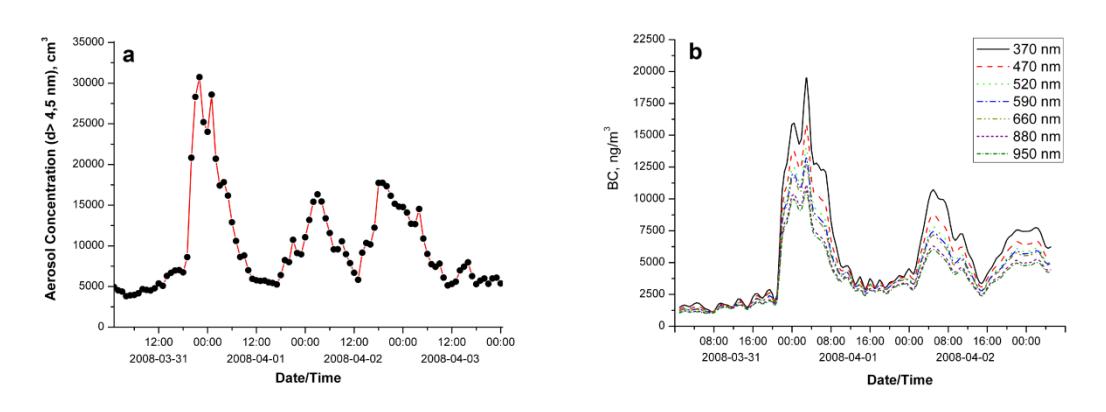
PM10 concentration exceeded the European PM10 limit value (50 μg/m3) during the same event in urban territories of Lithuania. High PM10 concentrations were measured in different districts of Vilnius. At Zirmunai station the PM10 limit values was exceeded 2-3 times on researched event. At Preila station aerosol concentration values were 10 times higher than usual, BC values – 20 times higher.