
In order to achieve higher level of synchronization and low timing jitter various active Q-switching techniques are used. Acousto - optic device applications can be divided into two categories: zero-beam order applications and diffracted beam applications. One of the zero-order beam applications is A-O Q-switching [1]. Q-switches are typically fabricated Tellurium Dioxide, Fused Quartz, or other acousto-optic materials [1].
Q-switches are designed for the conversion of RF energy into acoustic energy by attaching the transducer to the crystal with an vacuum metallized process. Transducers, placed on acousto-optic materials, forms standing acoustical wave, which works as diffraction grating with the period of acoustical wave. This effect causes appropriate losses inside the laser resonator, as part of incident photons diffracts to higher order maximums [2, 3].
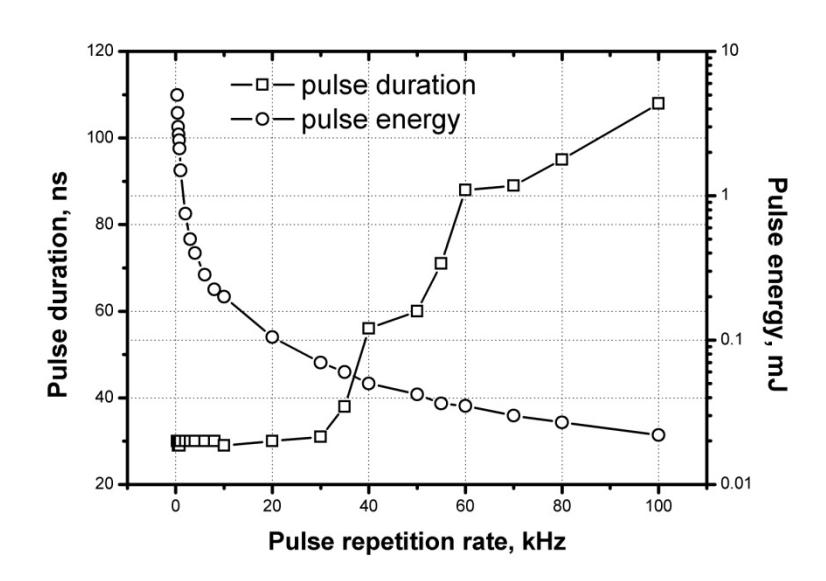
Experimental setup consisted from 2 mm. thick Yb (10%): YAG crystal, continuously pumped with 10 W fiber coupled 940 nm laser diode, acousto optical Q-switch and partial reflection curved output coupler. The laser was tested under various pulsing frequencies. The highest pulse repetition frequency was 100 kHz with pulse energy 22 μJ and duration 108 ns. The decrement of pulse repetition rate leaded to higher energy and shorter pulse pulses. The average power remained constant around 2 W in the region of 10 kHz – 100 kHz. When the pulse repetition frequency was set below 10 kHz, average power decreased to 1.5 W. Pulse duration dropped from 108 ns at 100 kHz, to 31 ns at 30 kHz and remained constant till the end of measurements at 300 Hz. The highest pulse energy achieved was 5 mJ at repetition rate of 300 Hz and pulse peak power of 167 kW.
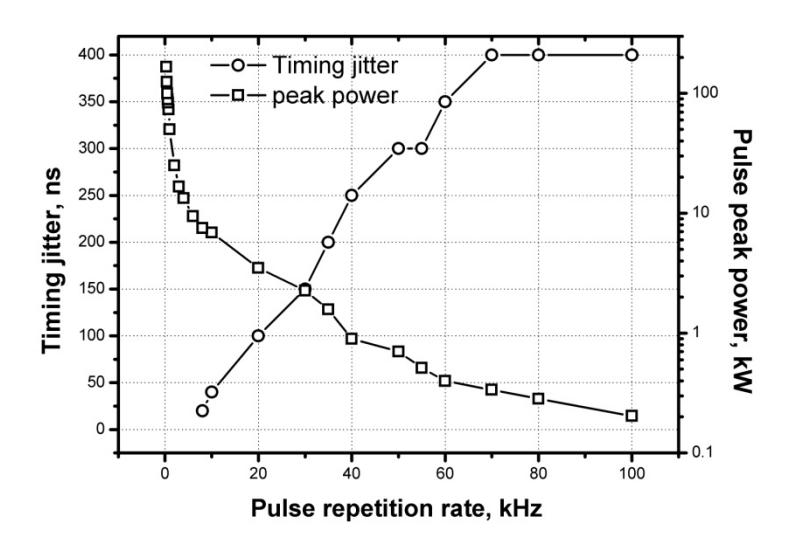
The timing jitter at 100 kHz pulse repetition was 400 ns, at 8 kHz it decreased to 20 ns. Forward decrement of pulse repetition leaded to timing jitter decrement, which was difficult to measure with equipment, used during experiment. The temporal profile of the laser pulse remained symmetrical in all operation frequencies. This can be explained by properties of Yb: YAG relatively low emission crossection, which causes low gain in laser resonator. During whole experiment laser was emitting single - TEM00 - transversal mode.