Interactions between light and molecules, adsorbed on the metal surface, are investigated widely in theoretical and experimental physics. In 1974 Fleischmann et al. experimentally observed an example of this interaction named surface-enhanced Raman scattering (SERS) [1]. Theoretical models that describe SERS can give results, comparable to vibrational experiments, but further improvement is necessary. Several hybrid theories have been introduced in this study. For example, a hybrid quantum mechanics / molecular mechanics methods are useful for modeling of charge transfer excitation energies in pyridine–silver complexes [2].
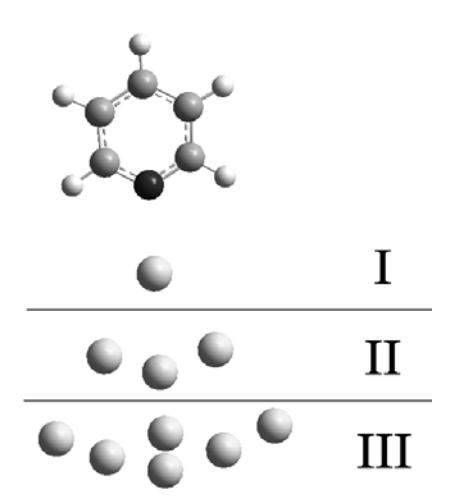
The object for our calculations is pyridine molecule (Pyr) near Ag20 cluster (Fig. 1). Pyridine molecule is one of the most often used objects in SERS experiments. Ag20 tetrahedral cluster is the face-centered cubic (FCC) lattice of silver atoms. This work is devoted to study electron transfer dynamics in Pyr..Ag20 cluster using Fermi golden rule equation:
$$W_{12} = \frac{2\pi}{\hbar} \left\langle \Psi_1 \middle| \hat{H}_{12} \middle| \Psi_2 \right\rangle^2 \rho (E_1 - E_2)\tag{1}$$
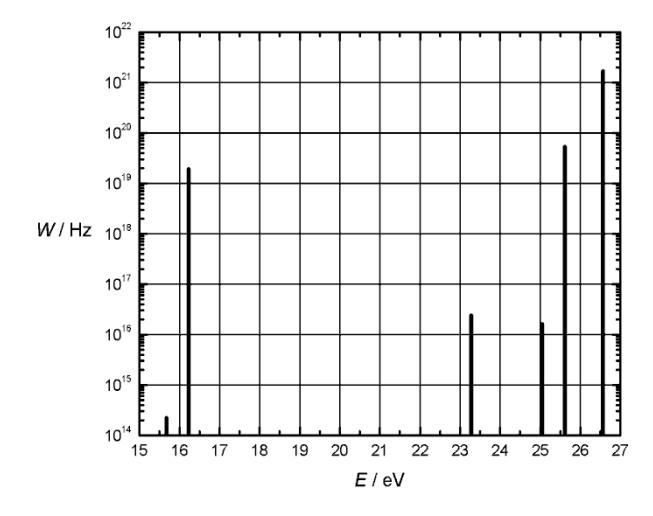
The calculations were made using GAUSSIAN03 [3] and NUVOLA [4] programs. Presented model allows to estimate electronic couplings between one-particle states: electronically excited states of Pyr and vacant (unoccupied) states of Ag20 cluster. Fig. 2 represents the rate of ET as function on state energy.
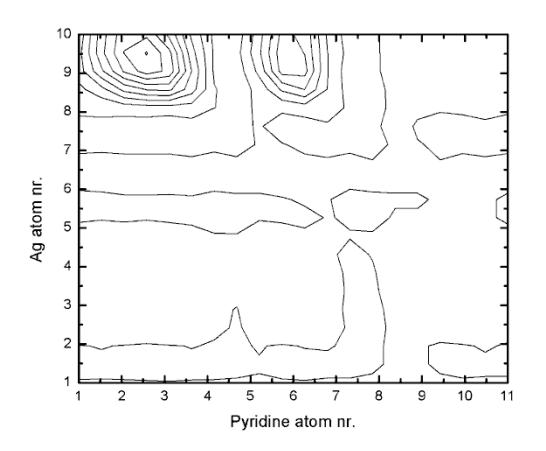
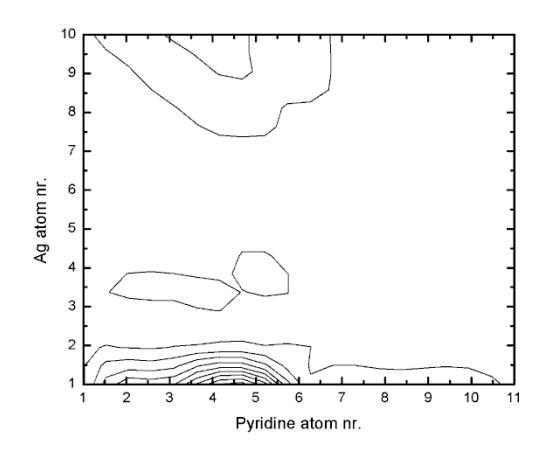
Fig. 3 and Fig. 4 show the two-dimensional maps of electronic charge redistribution which occurs after electron jumps: i) between Pyr atom number 6 (N) and Ag20 cluster atoms nr. 9 and nr.10; ii) between Pyr atoms nr. 2 (C) and nr. 3 (C) and Ag20 cluster atoms nr. 9 and nr.10; (both Fig. 3) iii) between Pyr atoms nr. 4 (C) and nr. 5 (C) and Ag20 cluster atom nr. 1 (Fig. 4). Both maps represents the charge transfer processes between third layer of Ag20 cluster and -CNC- chain of Pyridine when influence of the first and second layer of Ag20 cluster could be named as minimal. Presented results allow creating the model of charge transfer which allows to describe the role of the second and third layer of Ag20 cluster. Also orientational aspects of Ag20 cluster to Pyr molecule must be involved.