Optical interference coatings are thin film layers, which are used in surfaces of laser systems in order to increase their reflection/transmission or spectral efficiency. Vast majority of the interference coatings are made of fixed high and low refractive indexes layers by using conventional so called thermal deposition techniques. Typically such coatings are produced by electron beam or resistance heating evaporation as well as thermal evaporation with ion assisted beams. However main problems in such traditional coatings are related to their low optical resistance (they cannot withstand a high intensity of laser light), layer inhomogeneity, defects and roughness of the surface. Advanced IBS (Ion beam sputtering) technology with high kinetic energy particles [1, 2] allows avoiding similar problems and results in superior optical quality of the coatings. Furthermore it allows also vaporizing optical coatings by mixing different materials at the same time. That property of the process opens up the possibility to continuously tune the refractive index inside the coating. The rage of refractive indices is varied between the low and high indices of materials used for the mixture. Continuous change in refractive index allows fabrication of more complex coatings, in example so called Rugate Notch Filters and Chirped Mirrors. However before the applications of these mixtures in practice, it is necessary to investigate their optical properties with respect to material ratio in the coating. To our knowledge there is a lack of publications dedicated to the Nb2O5/SiO2 and ZrO2/SiO2 mixtures and their properties so the main goal of this study was complex characterization of such coatings. This study is governing the spectraphotometric reflectance/transmittance, total optical scattering, atomic force microscopy, X-ray diffraction and optical resistance measurements.
All the samples, in our experiments, were coated by IBS technology on fused silica (FS) substrates under the identical evaporation conditions. The optical thicknesses of all coatings were kept constant (6 QWOT – quarter wavelength of optical thickness). From spectrometric transmittance and reflectance measurements absorption $k$ values were evaluated (Fig. 1 and 2). At the same time, the volumetric proportions of high and low index materials were evaluated by using.
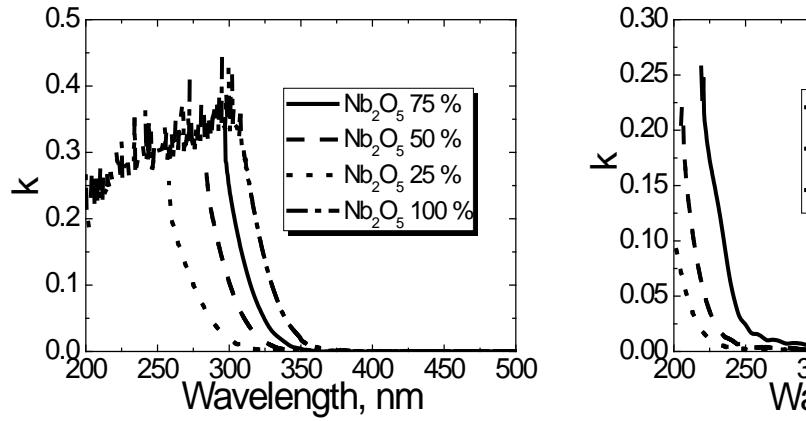
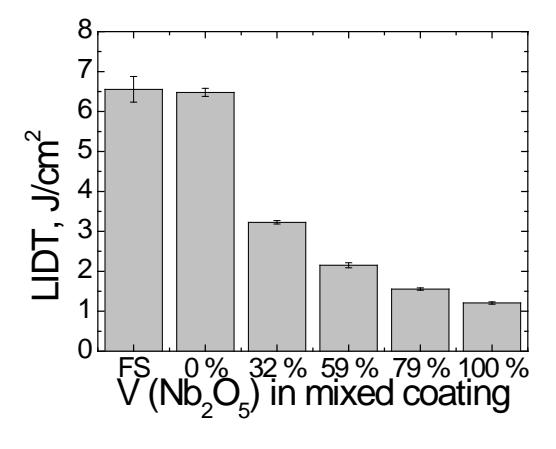
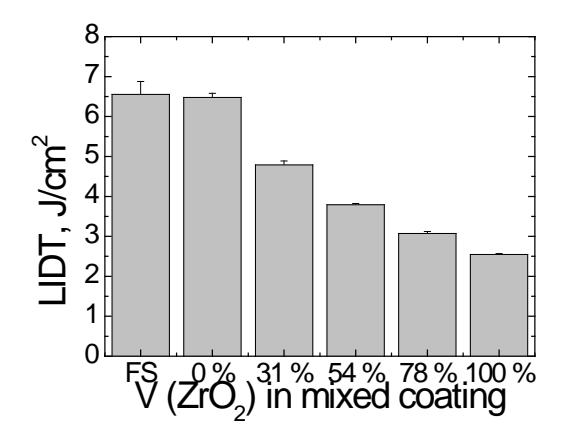
It was shown that increase of the high index material content in the coating results in the “red shift" of optical band-gap. This also influences the refractive index, optical scattering, roughens and optical resistance so called LIDT (Laser induced damage threshold) in femtosecond range (Fig. 3 and 4). All LIDT measurements were performed in 1-on-1 mode at 1030 nm wavelength.