
Egyptian sarcophagus of the god's Amon singer (Thebes XI - IX century BC) represents the core of ancient Egyptian art in M. K. Čiurlionis Art Museum. This is the only such exhibition in Lithuania. The study of materials used by the artist is useful both for the knowledge of the artwork and for conservation and restoring interventions using Kremer pigments [1, 2].
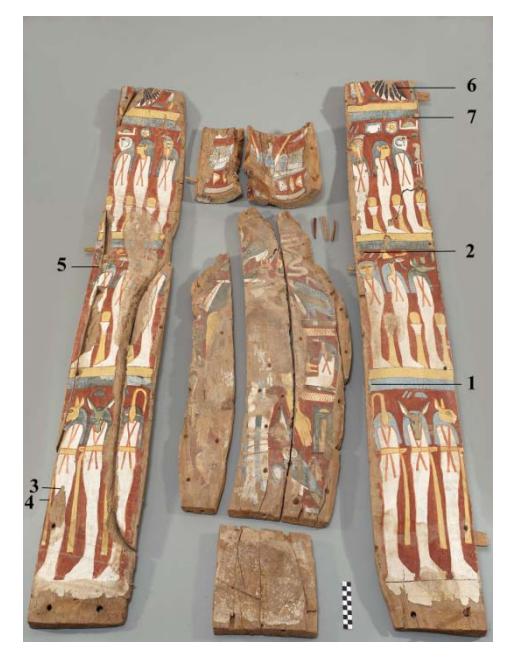
Spectroscopic methods are widely used in analysis of art polychromy. Fourier transform infrared spectroscopy (FT-IR) represents a powerful technique in diagnostic analysis of cultural heritage [1,3]. In this study the samples of sarcophagus were investigated by FT-IR absorption spectroscopyc, FT-IR microscopy and ATR methods.
Chalk, gypsum and animal glue were detected in all samples. The conclusion was made that sarcophagus soil consists of these materials. It was found that the green pigment is emerald green and azurite, white pigment is chalk and glue.
FT-IR absorption spectroscopy method is effective in the ground and soil spectral analysis, but for identification of pigments is insufficiently informative because of samples preparation method shortcomings. FT-IR microscopy and ATR techniques are suitable for sarcophagus surface spectra analysis.
A comparative analysis of the spectral methods (FT-IR, FT-IR microscopy, ATR and Raman) used in investigations of samples was performed.