
An ongoing objective in laser physics is to attain increasingly shorter light pulses. For this, pulse spectral broading is required. An extension of optical bandwidth by self-phase modulation in the bulk media, followed by post-compression is a simple and robust method to achieve even shorter light pulses. By using multiple plate approach instead of one continuous nonlinear medium, peak and average power scalability is introduced, leading to no further losses in efficiency [1]. Further investigation of new bulk media with optimal characteristics is necessary to achieve pulse spectral broadening in high repetition rate (tens of MHz) and high average power near-infrared laser systems. Recent studies have demonstrated that zinc sulfide (ZnS) and potassium gadolinium tungstate (KGd(WO\(_{4}\))\(_{2}\), KGW) crystals are emerging as potential materials for this purpose due to their relatively high resistance to multipulse optical damage and high nonlinearity compared to commonly used fused silica and sapphire [1-3]. 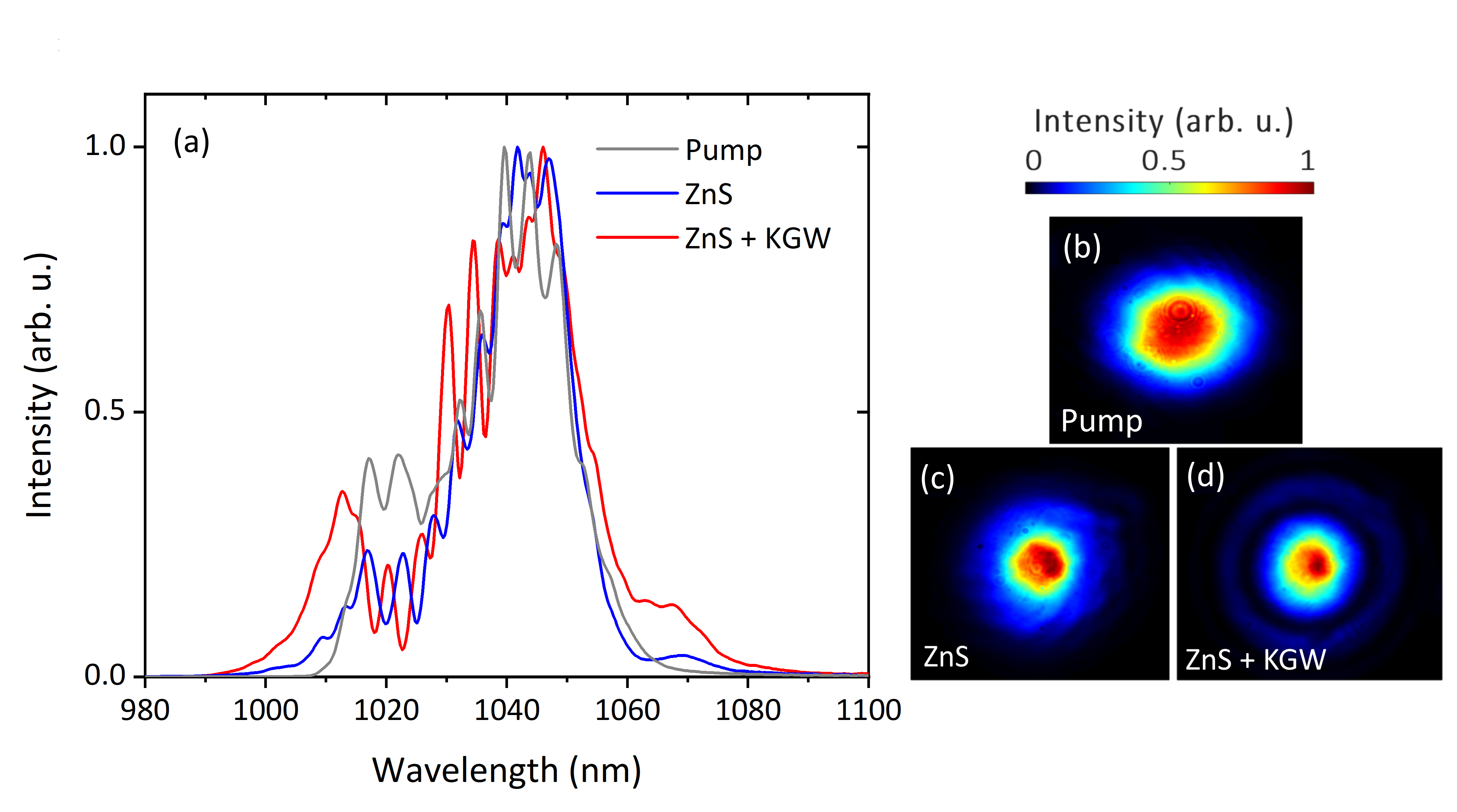
SPECTRAL BROADENING AND POST-COMPRESSION OF FEMTOSECOND PULSES IN ZnS AND KGW CRYSTALS AT 76 MHz REPETITION RATE
Matas Šutovas1, Vaida Marčiulionytė1, Jonas Banys1, Julius Vengelis1, Gintaras Tamošauskas1, Audrius Dubietis1
1 Laser Research Center, Faculty of Physics, Vilnius University
[1] M. Seidel, G. Arisholm, J. Brons, V. Pervak, O. Pronin, All solid-state spectral broadening: an average and peak power scalable method for compression of ultrashort pulses, Opt. Express 24, 9412-9428 (2016).
[2] V. Marčiulionytė, J. Banys, J. Vengelis, R. Grigutis, G. Tamošauskas, A. Dubietis, Low-threshold supercontinuum generation in a homogeneous bulk material at 76 MHz pulse repetition rate. Opt. Lett. 48, 4609-4612 (2023).
[3] M. Kowalczyk, N. Nagl, P. Steinleitner, N. Karpowicz, V. Pervak, A. Głuszek, A. Hudzikowski, F. Krausz, K. F. Mak, A. Weigel, Ultra-CEP-stable single-cycle pulses at 2.2 µm, Optica 10, 801-811 (2023).
[4] J. Banys, J. Vengelis, Efficient single-pass and double-pass pre-chirp managed Yb-doped rod-type fiber amplifiers using Gires–Tournois interferometric mirrors, Optik 249, 168185 (2022).