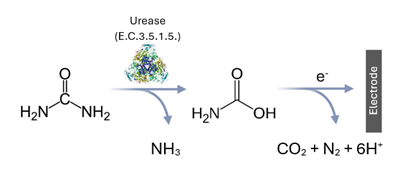
A graphene-baed nanomaterials discovered to be promising for the development of amperometric biosensors. These biosensors have a lot of advantages such as large surface area, which is beneficial for the immobilization of enzymas, high electrical conductivity, conditionally low prices, and good biocompatibility. The synergistic effect of functional chemical groups influences biosensor‘s sensitivity, selectivity, and overall electrochemical performance.\(^{1}\)
Traditional methods for urea determination often involve complex procedures and time-consuming analyses. Amperometric urea biosensors offer an innovative and effective alternative to these challenges with the potential applications in the medicine, agriculture or fertilizer industry. Its high sensitivity and selectivity enable precise and real-time monitoring of urea levels in soil, contributing to efficient fertilizer management. This not only assists in preventing over-fertilization, reducing environmental impact, and minimizing resource wastage but also ensures optimal nutrient delivery to crops, thereby enhancing agricultural productivity.\(^{2}\)
This study aimed to evaluate that the incorporation of positive amino or negative carboxyl functional groups into the reduced graphene oxide, in combination with urease, creates a meadiator-free amperometric urea biosensor (Fig. 1). We demonstrated that the incorporation of amino functional group into the reduced graphene oxide positively influences biosensor‘s parameters and electrochemical performance. Therefore, biosensor with amino functional groups has been applied in practical applications. The urea levels in fertilisers were investigated and the uptake of plant fertiliser was observed by measuring the urea concentration in soils. Also, the performance of the amperometric urea biosensor has been verified with an analogue colorimetric method.