Phthalocyanines are widely used for applications in electronics, solar cells, optical storage devices, etc., due to their photophysical characteristics. To understand phthalocyanines properties, it is beneficial to analyze their electronic structure, using quantum chemistry calculations. These calculations can provide useful insights into electronic excited states, which are particularly significant as they govern processes such as absorption of light, fluorescence, chemical reactions [1].
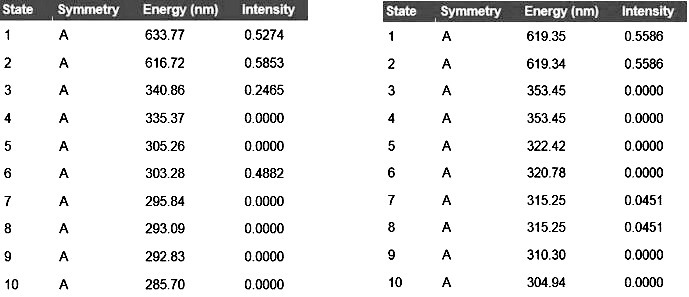
In the present work, quantum chemical calculations and analysis of Zinc 2,9,16,23-tetra-tert-butyl29H,31H-phthalocyanine (ZnTTBPc) and 2,9,16,23-tetra-tert-butyl-29H,31H-phthalocyanine (TTBPc) monomers were completed. At first, geometry of ZnTTBPc and TTBPc molecules was optimized in a vacuum using density functional theory (DFT) with three functionals: B3LYP, wB97X-D, LC-BLYP. Then the excited states values for each molecule were calculated using time-dependent density functional theory (TD-DFT). These calculations have shown that ZnTTBPc possess doublet degeneracy for the two lowest excited states [2] - such degeneracy arises from D4h point symmetry and in TTBPc case this degeneracy vanishes – the energy gap between the two lowest excited states is 15-150 nm, depending on the functional employed. The obtained results correlate with the experimental data [3]. After the initial set of calculations with monomers the next step was to examine the collective states of dimers using the same procedure. In this work it is also considered whether the results with monomers and dimers change when considering the environment – which is described with the polarizable continuum model (PCM). Chloroform was used as the solvent.