
Organic light-emitting diodes (OLEDs) technology has outperformed other technologies in recent decades [1]. OLEDs are the ultimate technology for display and are stepping rapidly into lighting. At present, there is an intensive need for high-performance deep-blue emitters in full-color display and solid-state lighting . However, as the emission peaks shift towards the deep-blue region, the nonradiative transition rate of metal d-orbitals tends to increase, making it difficult to achieve a high efficiency altogether [2]. To solve the problem, small-molecules fluorescent materials have re-gained attention due to their high color purity and low cost. The synthesis of bicarbazole-based host materials was carried out by the three-step synthetic route as shown in Figure 1. Herein, we introduce a series of donor-acceptor-donor (D-A-D) twisted derivatives based on carbazole-benzophenone moieties. 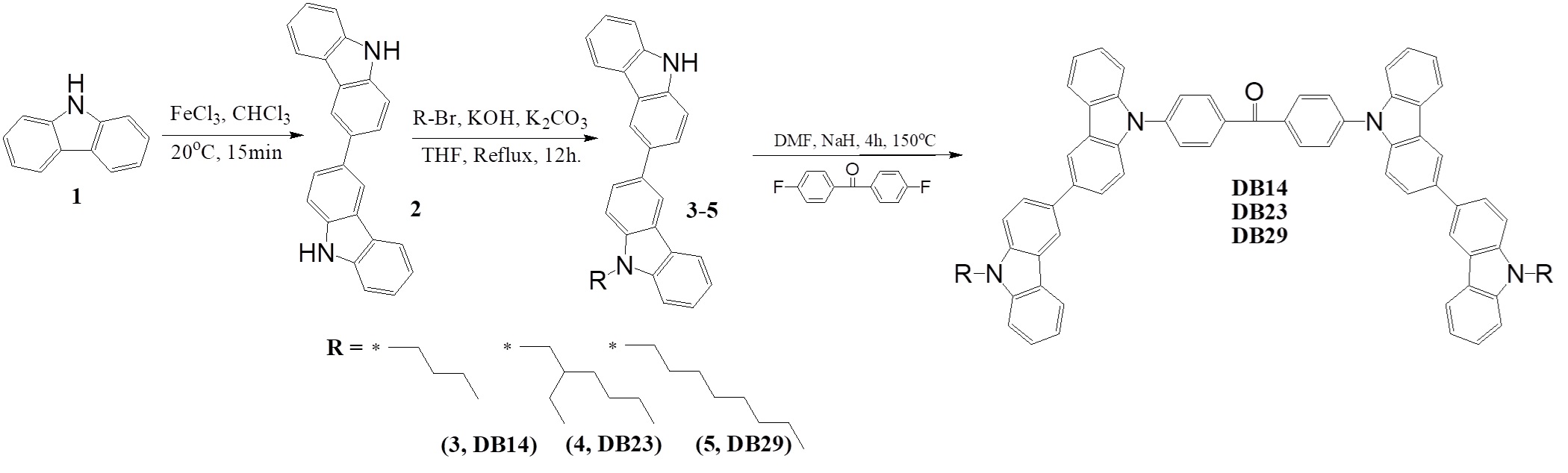
BENZOPHENONE-BASED TWISTED DONOR-ACCEPTOR-DONOR DERIVATIVES AS BLUE EMITTERS FOR HIGHLY EFFICIENT FLUORESCENT OLEDS
Dovydas Blazevicius1, Iram Siddiqui2, Prakalp Gautam2, Gintare Krucaite1, Daiva Tavgeniene1, Mangey Ram Nagar2, Krishan Kumar3, Subrata Banik4, JwoHuei Jou2, Saulius Grigalevicius1
1 Department of Polymer Chemistry and Technology, Kaunas University of Technology, Lithuania
2 Department of Materials Science and Engineering, National Tsing Hua University, Taiwan
3 School of Chemical Sciences, Indian Institute Of Technology-Mandi, Kamand 175005, Himachal Pradesh, India
4 Department of Chemistry, School of Chemical and Biotechnology, SASTRA Deemed University, Thanjavur 613401, Tamil Nadu, India
Acknowledgments: We acknowledge support from the Research Council of Lithuania (grant No. S-MIP-22-84).
[1] C.-Y. Chan, L.-S. Cui, J. Kim, H. Nakanotani, C. Adachi, C. Chan, L. Cui, J.U. Kim. Rational Molecular Design for Deep-Blue Thermally Activated Delayed Fluorescence Emitters, Advanced Functional Materials 28, 1706023 (2018).
[2] J.H. Lee, C.H. Chen, P.H. Lee, H.Y. Lin, M.K. Leung, T.L. Chiu, C.F. Lin. Blue Organic Light-Emitting Diodes: Current Status, Challenges, and Future Outlook. Journal of Materials Chemistry C 7, 5874–5888 (2019)