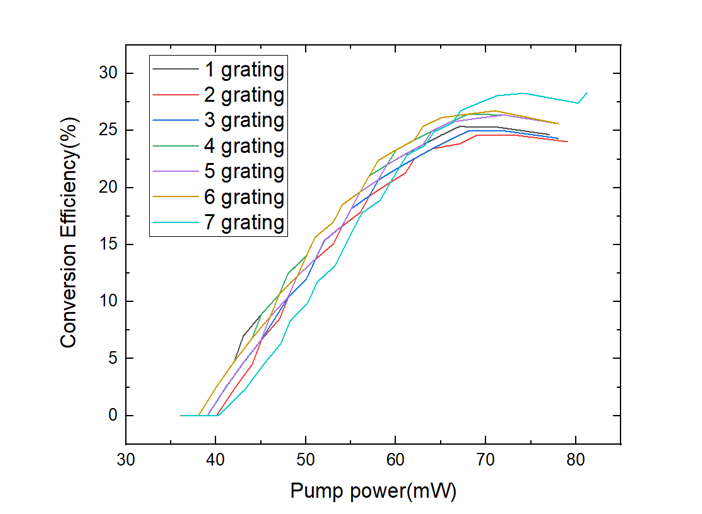
Nowadays lasers have become necessary optical device capable of converting light from its natural incoherent state to coherent state. However, lasers have spectral limitations making wavelength extremely hard to change. In order to change the wavelength of laser radiation, parametric light generators are used which have a distinctive flexibility enabling them to provide radiation in an entire spectral range. Mostly optical parametric light generators are within ultrashort (less than 300 ps) and long (more than 1 ns) pulse durations, nevertheless due to certain physical limitations effective subnanosecond pulse (less than 1 ns and more than 300 ps) generators have not been constructed yet [1-3]. The aim of this work was to construct and investigate MgO:PPLN optical parametric generator pumped by second harmonic of subnanosecond Nd:YAG microlaser which will be used in the subsequent optical parametric amplifier system tuneable in the visible spectrum range. Additionally, investigate the latter crystal’s properties In this work the spectral and energy characteristics of the constructed OPG were measured. During optical parametric generation MgO:PPLN optical crystal gratings were from 6.85 µm to 8.65 µm and at 90°C difference frequency wave (idler wave) range was 1060 – 2160 nm, in near part of IR spectrum, and the signal was from 702 nm to 1060 nm, The maximum signal power at 1060 nm was 71 mW and the overall conversion efficiency at 1060 nm obtained 28.3