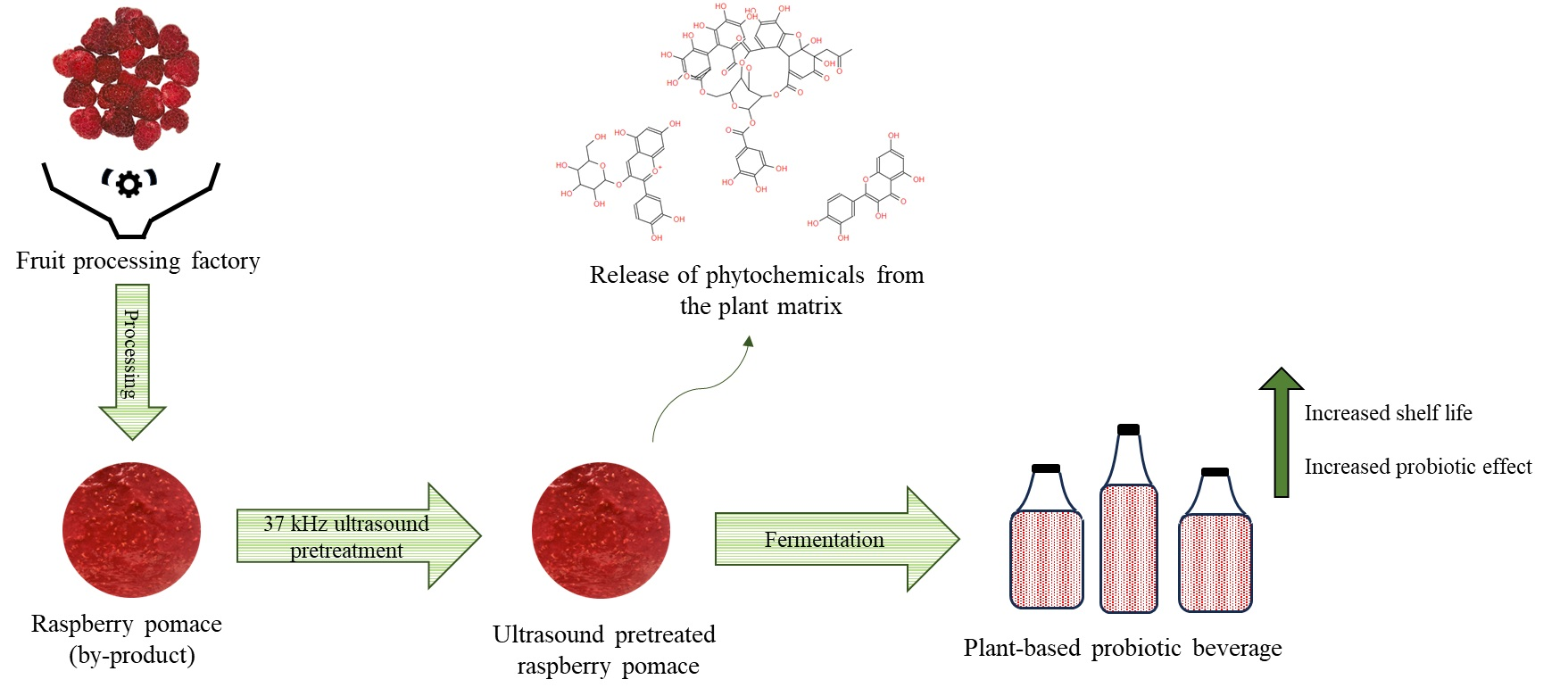
As the human population continues to grow, the consumption of food products increases, which leads to the accumulation of organic waste and by-products of food processing industry. Berry pomace, including raspberry pomace, is a by-product of the berry processing industry, which has a limited application due to the high water content and the risk of microbiological spoilage. Commonly, raspberry pomace is thrown away as waste, composted or used in feed. In alignment with the principles of sustainability and the European Commission’s Circular Economy Action Plan, this research aims to utilize the by-products of the food processing industry in the development of value-added products.
Raspberry pomace is rich in phytochemicals that exhibit antimicrobial and antioxidant properties [1]. These biologically active compounds can be applied as an alternative to pasteurization or chemical preservatives that can help to reduce the growth of technologically and nutritionally harmful microorganisms during fermentation process [2].
Low frequency (37 kHz) ultrasound at different intensities was applied to fresh raspberry pomace at 35 °C for 15, 30 and 45 min. Ultrasonication is an innovative and environmentally friendly method for pretreating raw materials and extracting biologically active compounds [3]. The efficiency of ultrasonication was characterized by the increase of total concentration of phenolic compounds, total concentration of anthocyanins and antioxidant activity of raspberry pomace water suspensions.
The production of fermented beverage involved the use of ultrasound pretreated raspberry pomace and symbiotic culture. To further enhance the microbial stability and probiotic effect of the beverage, additional lactic acid bacteria (LAB) were added at effective concentrations. It was found that the usage of pretreated raspberry pomace during fermentation process resulted in more microbiologically stable beverages compared to the control. In addition, it showed a significant increase in LAB and yeast concentration compared to the control. These findings suggest that the by-product of the berry processing industry may be a promising source of phytochemicals that could be used for the production of probiotic fermented beverages.