
Optical parametric generators (OPGs) play important roles as tunable laser sources in the near- to mid-infrared region. Most commercially available OPGs operate within ultrashort (less than 100 ps) or long (more than 500 ps) pulse durations. The subnanosecond range between these values is largely unexploited due to the low optical damage threshold of the crystals. Several theoretical models have been proposed [1-3], however, none of them consider pump pulse being depleted as its energy is converted to signal and idler waves. The goal of this investigation was to create a model for optical parametric generation in periodically poled lithium niobate (PPLN) crystal, pumped by subnanosecond pulses when pump depletion is active.
Firstly, we utilised a quantum mechanical model [4,5] to define an effective length of quantum noise generation, then, we applied classical three wave interaction formulas and symmetrized split-step Fourier transform method to simulate the wave propagation in the PPLN crystal. This allowed us to compare the outputs of the parametric generation for different numbers of initial noise photons.
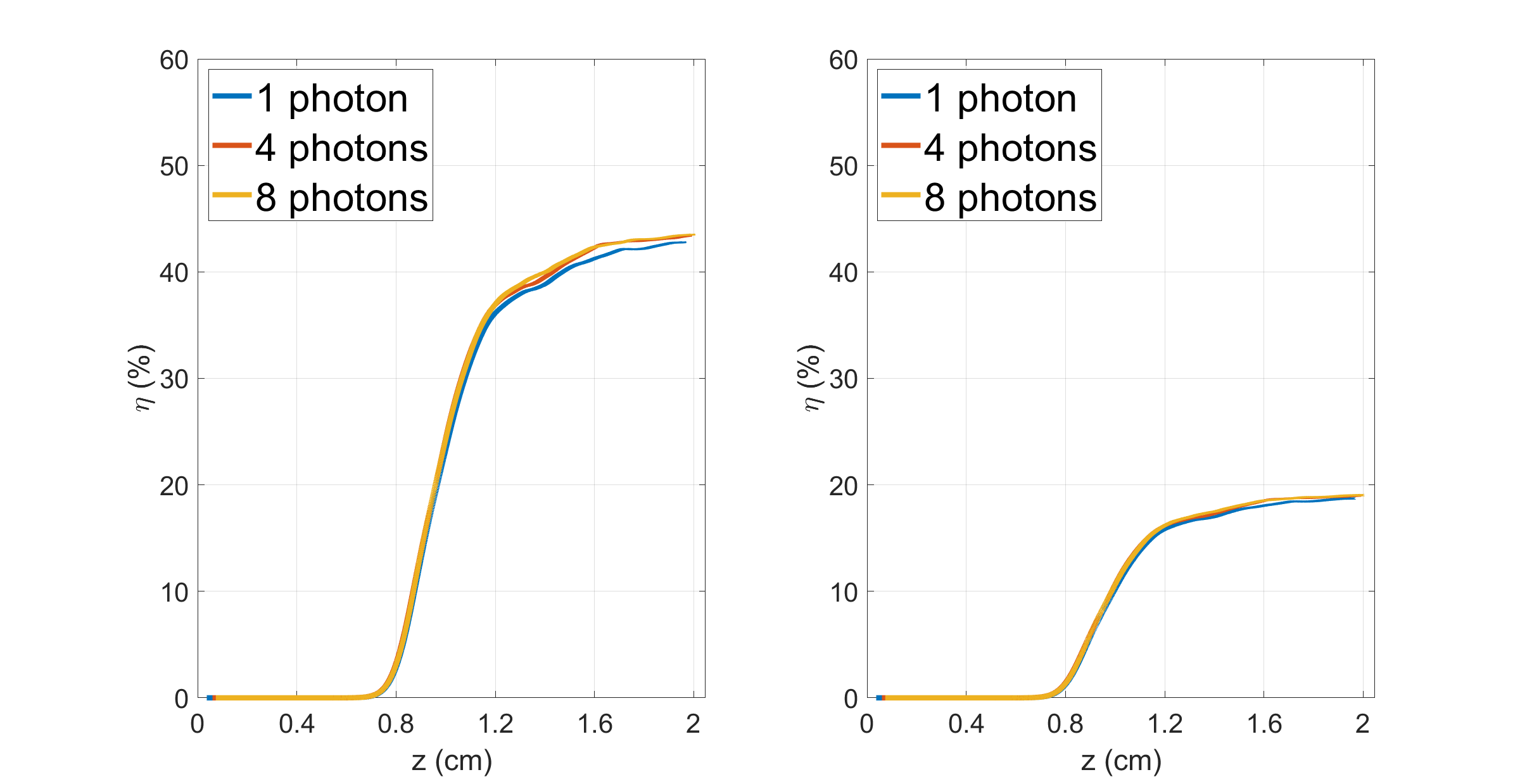
As seen in figure 1, the energy conversion curves match well if the propagation axis is moved by the effective length over which 1, 4 or 8 noise photons are generated. In each case, the curves saturate at \({\sim}43 \%\) for the signal and \({\sim}19 \%\) for the idler wave. The shapes of the temporal and spatial intensity profiles for different number of photons were also similar. In addition, by varying the crystal grating period \(\Lambda\), we calculated the spectral widths (FWHM) for 6 gratings. Larger \(\Lambda\) values lead to spectral widths increase from \(6.1\,\mathrm{nm}\) to \(11.6\,\mathrm{nm}\) for the signal and \(55.6\,\mathrm{nm}\) to \(74.4\,\mathrm{nm}\) for the idler.
To conclude, the developed model should provide a basis for understanding the optical parametric generation process in the subnanosecond regime and support the results of further research and development of more effective subnanosecond OPG systems under pump depletion.