
The emergence of nanotechnology has opened up new horizons for the development of electrochemical biosensors [1]. Some notable properties of nanomaterials, such as high surface area and the ability to facilitate charge transfer between the redox center of the enzyme and the electrode, are exploited in the design of biosensors to improve sensitivity and selectivity and reduce response time [2]. Dendritic gold nanostructures (DGNs) are novel nanomaterials that show great promise in various biomedical applications [3]. Various conducting polymers such as polyaniline (PANI) [4] and polypyrrole (Ppy) [5] are widely used in electrocatalysis and for the immobilization of biological molecules. The main aim of the investigations was to evaluate the efficiency of PANI and Ppy layers formed by enzymatic polymerization on the surface of the graphite rod (GR) electrode initially premodified by electrochemically synthesized DGNs and drop-casted glucose oxidase (GOx). The principle of DGNs electrochemical formation, enzymatic polymerization on GR electrode and electrochemical investigation in the presence of phenazine methosulfate (PMS), are represented in Fig. 1. Analytical characteristics of biosensors based on PANI/GOx/DGNs/GR and Ppy/GOx/DGNs/GR electrodes were evaluated and compared. It was investigated that glucose biosensor based on Ppy/GOx/DGNs/GR electrode was characterized by 0.0594 mA/mM cm\(^2\) of sensitivity, 0.070 mM of the limit of detection, until 19.9 mM linear glucose determination range, 7.39 proc. of the repeatability and 33 days of the storage stability. Improved glucose biosensor based on the Ppy/GOx/DGNs/GR electrode was successful applicable in real samples (human serum and saliva, milk, juce and wine). Developed glucose biosensor could be used for biomedical purposes, for food and beverage control and biofuel cells. 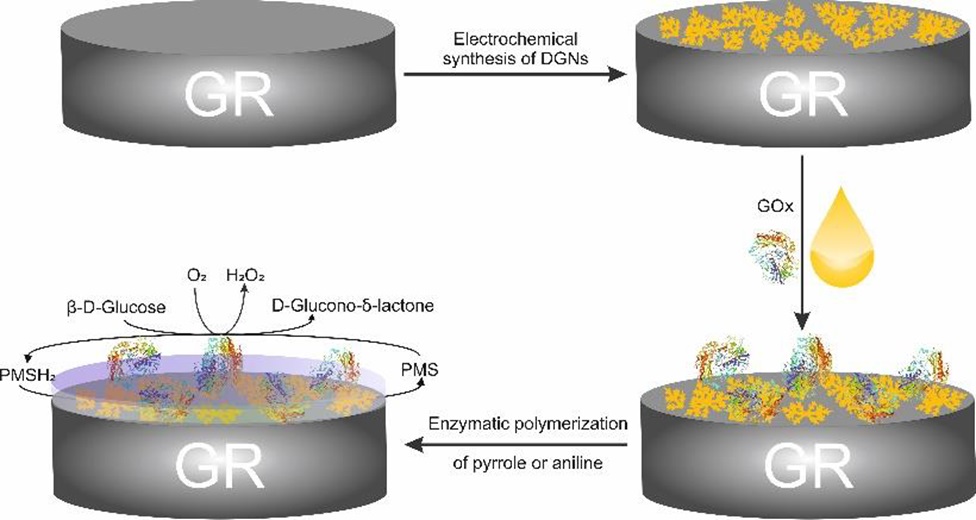
THE DEVELOPMENT OF GLUCOSE BIOSENSOR BASED ON DENDRITIC GOLD NANOSTRUCTURES MODIFIED BY CONDUCTING POLYMERS
Natalija German1, Anton Popov1, Arunas Ramanavicius2, Almira Ramanaviciene1
1 State Research Institute Centre for Innovative Medicine, Department of Immunology and Bioelectrochemistry, Vilnius, Lithuania
2 Vilnius University, Department of Physical Chemistry, Faculty of Chemistry and Geosciences, Vilnius, Lithuania
Acknowledgments: This research was funded by a grant (No. S-MIP-20-18) from the Research Council of Lithuania.
[1] J. Wang, Nanomaterial-based electrochemical biosensors, Analyst 130, 421–426 (2005).
[2] H. Heli, O. Amirizadeh, Non-enzymatic glucose biosensor based on hyperbranched pine-like gold nanostructure, Materials Science and Engineering C 63, 150–154 (2016).
[3] A. Ramanaviciene, N. German, A. Kausaite-Minkstimiene, A.Ramanavicius, Glucose biosensor based on dendritic gold nanostructures electrodeposited on graphite electrode by different electrochemical methods, Chemosensors 9 (2021).
[4] K. Crowley, M.R. Smyth, A.J. Killard, A. Morrin, Printing polyaniline for sensor applications, Chemical Papers 67, 771–780 (2013).
[5] N. German, A. Ramanavicius, J. Voronovic, A. Ramanaviciene, Glucose biosensor based on glucose oxidase and gold nanoparticles of different sizes covered by polypyrrole layer, Colloids and Surfaces A: Physicochemical and Engineering Aspects 413, 224–230 (2012).