
Cavitands are macrocyclic molecules containing a permanent intramolecular cavity for non-covalent binding of guest molecules. The most commonly encountered types of cavitands are cyclodextrins and cyclic phenol-formaldehyde oligomers. Such compounds have many potential applications as synthetic enzymes\(^{1}\), drug delivery systems\(^{2}\), or filters for removing polyaromatic contaminants from aqueous systems\(^{3}\). However, existing cavitand designs suffer from high symmetry and poor capabilities of functionalization and cavity size modification, which severely limits their potential.
Our current research is based around a system that enables the modular synthesis of various different-sized cavitands from a small selection of molecular building blocks through cyclocondensation reactions. The system is centered around derivatives of bicyclic V-shaped compound 1. Methods for the synthesis and resolution of enantiomerically pure (+)-1\(^{4}\) and both enantiomers of the heterocyclic variant (+)-2 and (-)-2\(^{5}\) have been developed. Bifunctionalized symmetric synthons 5 and 6 for Friedlander and Fischer cyclocondensations have also been successfully synthesized and tested in the corresponding condensation reactions. However, synthesis of cavitands has been unsuccessful due to solubility problems and self-condensation side reactions emerging after functionalization with bulky solubilizing groups. Future plans include alternative routes of functionalization and synthesis of model cavitands. 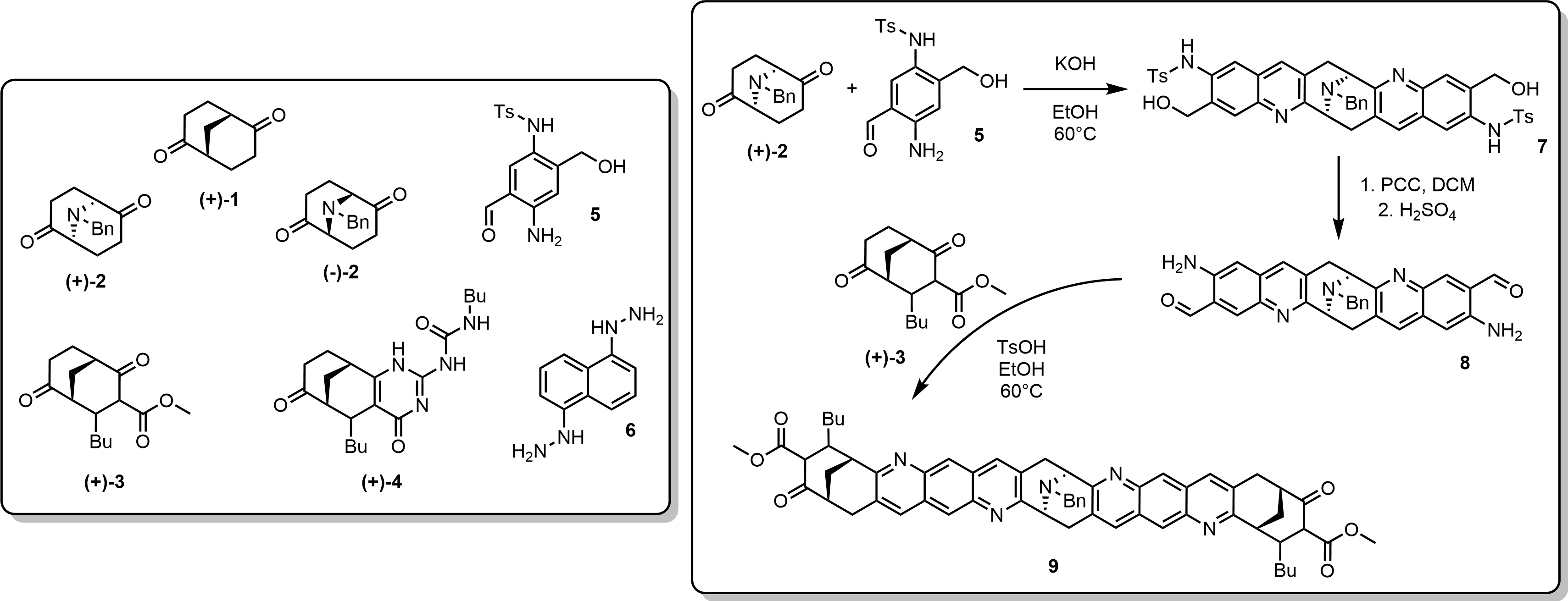
DESIGN AND SYNTHESIS OF MOLECULAR BUILDING BLOCKS FOR MODULAR SUPRAMOLECULAR CAVITANDS
Nojus Radzevičius1, Edvinas Orentas1
1 Institute of Chemistry, Faculty of Chemistry and Geosciences, Vilnius University, Naugarduko str. 24, Vilnius, Lithuania
[1] B.W. Purse, P. Ballester and J. Rebek, Reactivity and molecular recognition: amine methylation by an introverted ester, J Am Chem Soc, 125, 14682 (2003)
[2] R. Challa, A. Ahuja, J. Ali and R.K. Khar, Cyclodextrins in drug delivery: An updated review, AAPS PharmSciTech, 6, E329 (2005)
[3] A Pedrini et al., Reusable Cavitand Based Electrospun Membranes for the Removal of Polycyclic Aromatic Hydrocarbons from Water, Small, 18, 2104946 (2022)
[4] C.J. Wallentin et al., Bakers Yeast for Sweet Dough Enables Large Scale Synthesis of Enantiomerically Pure Bicyclo(3.3.1)nonane 2,6 dione, Synthesis (Stuttg), 2009, 864 (2009)
[5] V. Bieliunas, D. Račkauskaitė, E. Orentas and S. Stončius, Synthesis, enantiomer separation, and absolute configuration of 2,6 oxygenated 9 azabicyclo(3.3.1)nonanes, J Org Chem, 78, 5339 (2013)