
The applicability of scintillators in the detection of ionizing radiation depends predominantly upon several key parameters, including their light yield, scintillation decay time, afterglow characteristics, radiation tolerance, and energy resolution. Scintillators with a cerium-doped multi-component garnet structure have demonstrated a high light yield and a strong resistance to ionizing radiation. These attributes make them particularly suitable for application in high-energy physics experiments and medical imaging. Nonetheless, a significant limitation of these crystals is their susceptibility to the formation of substitution-type defects, which degrade their scintillation response time—a critical parameter for their effectiveness. One proposed solution for this issue involves the fabrication of scintillators by the liquid-phase epitaxy (LPE) method. This process is conducted at lower temperatures, which is hypothesized to result in a reduced probability of defect formation. The aim of this study study is to investigate the impact of compositional variations on the optical properties of scintillators grown by the LPE method.
Four samples of cerium-doped multicomponent garnet structure scintillators grown on an undoped YAG substrate were investigated: Lu\(_3\)Al\(_5\)O\(_{12}\):Ce, Y\(_3\)Al\(_5\)O\(_{12}\):Ce, Tb\(_3\)Al\(_5\)O\(_{12}\):Ce, and Gd\(_{2,5}\)Al\(_{0,5}\)AG:Ce. 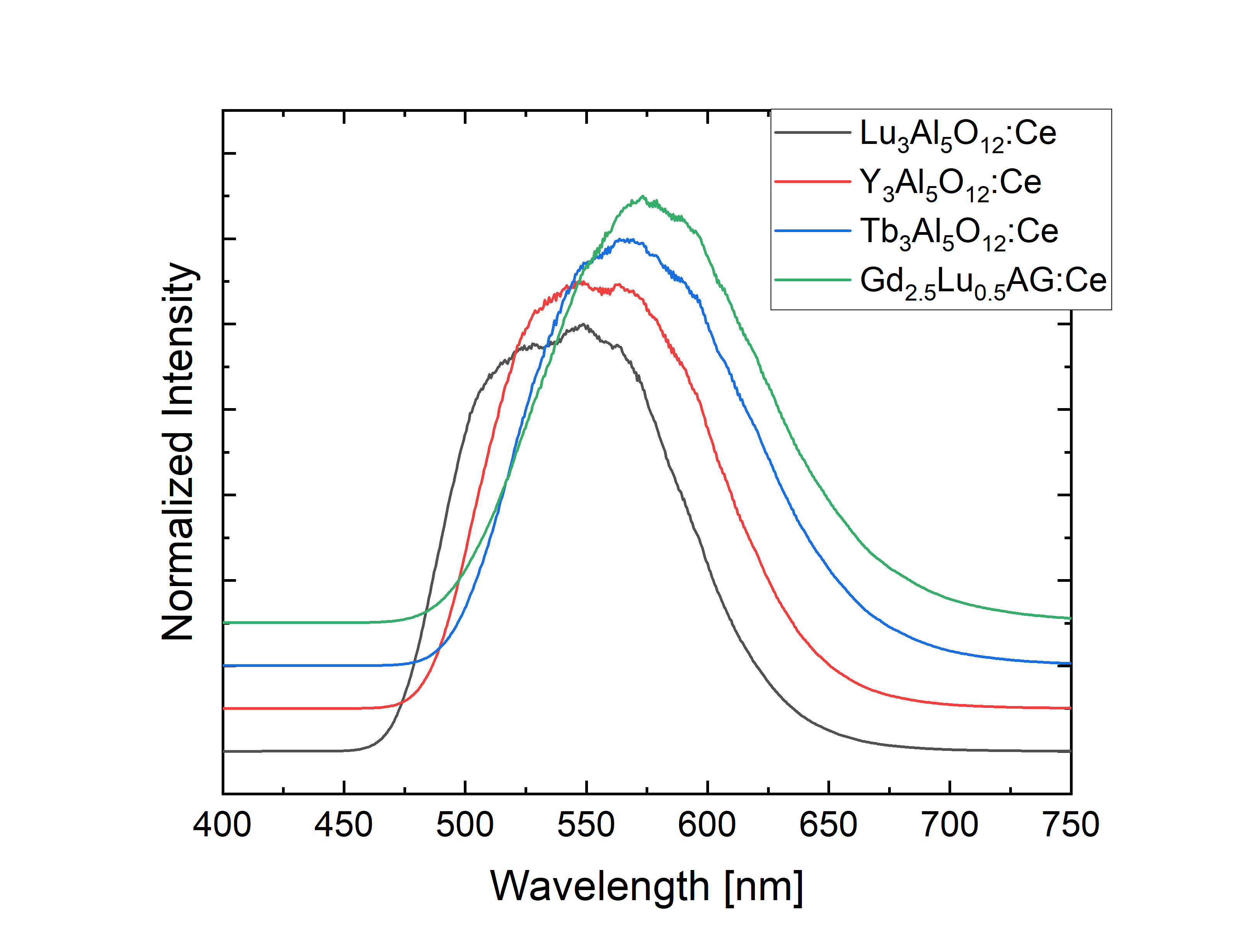
The experiments showed that the photoluminescence spectrum exhibits the greatest redshift in Gd\(_{2,5}\)Lu\(_{0,5}\)AG:Ce relative to the Lu\(_3\)Al\(_5\)O\(_{12}\):Ce garnet, as illustrated in Figure 1. There is a decline in average intensity corresponding with the increase of ionic radius, following the order Lu\(^{3+}\)<Y\(^{3+}\)<Tb\(^{3+}\)<Gd\(^{3+}\). The Tb\(_3\)Al\(_5\)O\(_{12}\):Ce sample demonstrated the highest variability in intensity, wavelength distribution, and the temperature-dependence of scintillation decay. These results are interpreted by the difference in ionic radius of Lu\(^3+\), Y\(^3+\), Tb\(^3+\) and Gd\(^3+\) ions in the scintillator matrix and the interaction of the lattice-building atoms with activator ions Ce\(^3+\), as well as by the structural inhomogeneities in the scintillator layers occurring in the growth process.