
Intense, few-cycle laser sources in the wavelength range 1.5 – 3.0 \(\mu\)m are in demand for generating THz and attosecond X-ray pulses [1]. Invented by Lithuanian scientists from the group of A. Piskarskas, the optical parametric chirped pulse amplification (OPCPA) when operating in degeneracy at \(\sim\)2 \(\mu\)m allows the use of readily available \(\sim\)1 \(\mu\)m driving pulses, while supercontinuum (SC) seed simplifies the design by eliminating the need for active synchronization. We demonstrate a compact, high-efficiency mJ-level mid-IR OPCPA using 1.2 ps pulses from Yb:YAG laser for both pumping and SC generation. Three degenerate OPCPA stages based on BiBO crystals provide output pulses with an energy of \(\sim\)2.5 mJ in the wavelength range of \(\sim\)1.8 – 2.3 \(\mu\)m. Preliminary results on spectral expansion beyond \(\sim\)3 \(\mu\)m using stimulated rotational Raman scattering (SRRS) in a gas cell will also be reported.The Yb:YAG chirped pulse amplifier with a grating compressor [2], upgraded by the author of the report, was used as a pump source for both SC and OPCPA allowing 1.5 times better gain (Fig. 1, left). Beam stability was ensured by auto-alignment. The SC seed pulses were generated in a YAG crystal 130 mm long [3]. Compared to the previous implementation the SC seed pulse dispersion has been optimized using an acousto-optic programmable dispersive filter (AOPDF) to provide the best conversion efficiency and ultimate pulse compression. 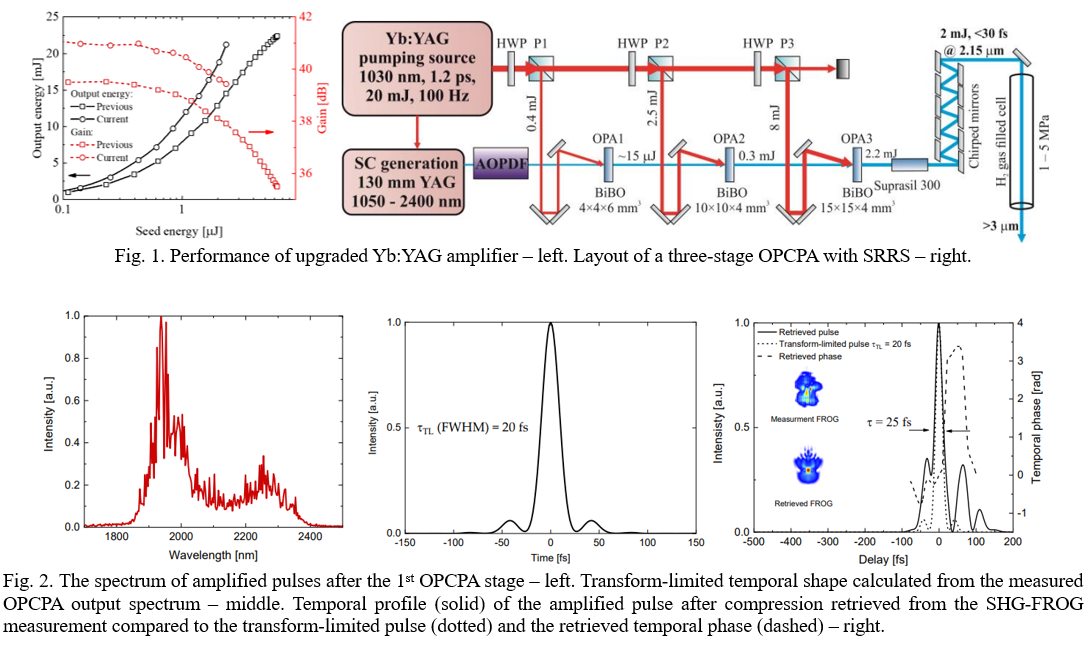
HIGH-EFFICIENCY MID-IR OPCPA WITH 2.5 mJ 25 fs OUTPUT PULSES
Augustė Černeckytė1, Augustinas Petrulėnas1, Paulius Mackonis1, Aleksėj M Rodin1
1 Solid State Lasers laboratory, Center for Physical Sciences and Technology, 231 Savanoriu Ave, 02300 Vilnius, Lithuania
[1] P. Agostini and L.F. DiMauro, The physics of attosecond light pulses, Rep. Prog. Phys. 67, 813–855 (2004).
[2] P. Mackonis and A.M. Rodin, Laser with 1.2 ps, 20 mJ pulses at 100 Hz based on CPA with a low doping level Yb:YAG rods for seeding and pumping of OPCPA, Opt. Express 28, 1261–1268 (2020).
[3] A. Petrulenas, P. Mackonis, and A. M. Rodin, High-efficiency bismuth borate-based optical parametric chirped pulse amplifier with approximately 2.1 mJ, 38 fs output pulses at approximately 2150 nm. High Power Laser Sci. 11 (2023).