
Terahertz (THz) radiation, falling within the millimeter-micrometer wavelength range (0.1 THz - 10 THz) [1], represents a low-power, non-destructive form of electromagnetic waves. This unique region necessitates a combination of electronics and photonics methods for both radiation emission and detection [2]. THz radiation possesses a notable advantage in penetrating various dielectric objects like paper, rubber, and textiles. It has found applications in security, production quality control, imaging, and bio-fabric analysis [3]. Traditionally, these applications relied on costly and bulky lenses or mirrors for beam propagation control. However, metalenses, a combination of diffractive zoneplate lenses with metaatoms, offer a solution by utilizing smaller-than-wavelength geometrical shapes, specifically split ring resonators, for phase delay and polarization rotation [4].
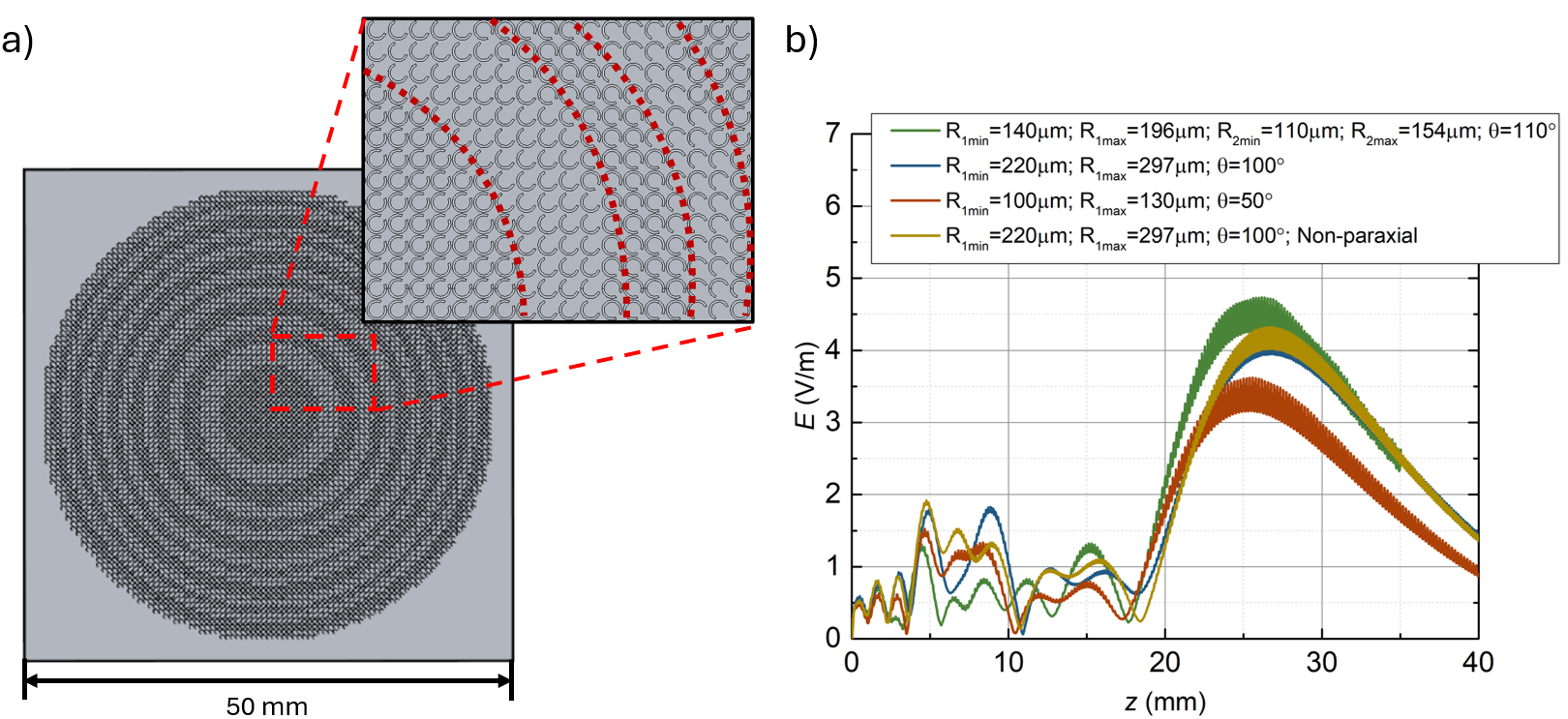
In this research different sizes CSRR were used as phase delaying metaatoms for periodically changing subzones in Fresnel diffractive lens designs. Metaatoms shapes were precisely chosen to have delay difference equal to \(\pi/2\) for lenses with 4 subzones. Traditional and Non-paraxial adjusted lens models created for 250 GHz frequency and simulations performed applying FTDT method.
Results show very similar focusing efficiency and performance regarding size and aberration adjustments, with the best performing (\(R_{1min}=140\mu m\),\(R_{1max}=196\mu m\), \(R_{2min}=110\mu m\), \(R_{2max}=154\mu m\), \(\theta=110^{\circ}\)) lens. Non-paraxial design demonstrates higher electric field at focal point. The metalens also induces polarization rotation based on CSRR orientation.
Research was funded by Lithuanian Science Council, project number: S-ST-23-190