Inertial confinement fusion(ICF) is a nuclear fusion reaction that takes place by compressing and heating small pellets targets, that usually contain isotopes of hydrogen. Energy is disposed on the target’s outer layer, which explodes and creates shock waves during the whole target. It is widely used for energy production. One of the main advantages of using foam targets for inertial confinement fusion reactions is that they can provide a low density with a high mechanical stiffness.[1] Additionally, parametric instabilities are sensitive to the plasma temperature and the density scale length, and those parameters are easily controlled using foams. Acrylate materials provide low density and it’s the first time that woodpiles are fabricated with them using green light using two photon polymerization, which provides high precision in creating three-dimensional nanostructures, as foams.[2]
In this work, main goal is to investigate the fabrication parameters that provide high porosity woodpile foams with straight lines and the minimum possible shrink. These parameters are the writing speed, the average power and the development of the structures. The right material and geometry were investigated in order 3D woodpile foams of dimensions 1 mm in X and Y axis and \(500\ \mu\)m in Z axis to be fabricated using two photon lithography. The laser that was used for fabrication was Nanofactory with wavelength 517 nm and the objective was Mitutoyio 50x0.75 NA. The materials that were used are PETA (Pentaerythritol triacrylate), PETTA (Pentaerythritol tetraacrylate) and (PETA:PETTA)(60:40). Also, the suitable photoinitiator was also investigated. Irgacure 369 and Thioxanthen 9-one alfa were used in different concentrations.
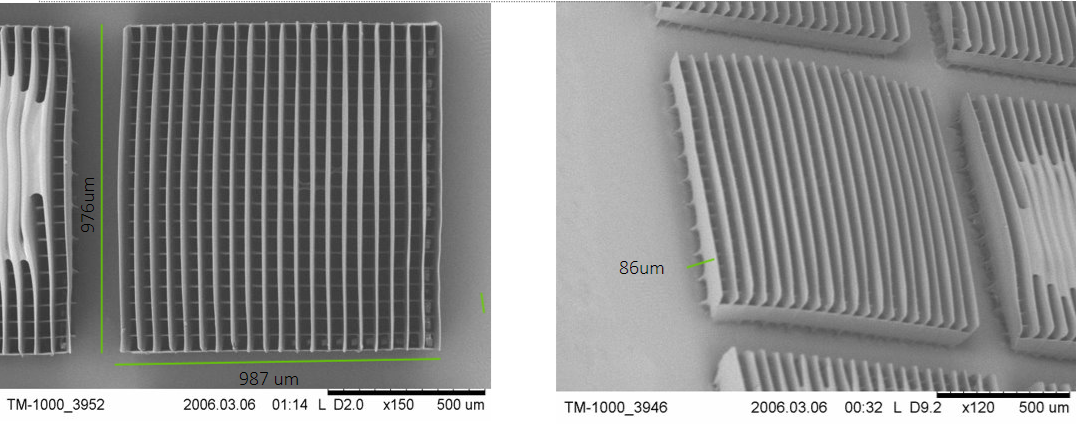
This far, the best results came from structures of (PETA:PETTA)( 60:40) and thioxanthen-9-one alfa 0.5%. The speed of the laser is 50 mm/s and the power 40 mW. The X and Y length is 1mm and the model’s height \(90\ \mu\)m. In X and Y axis the porous size is \(50\ \mu\)m and in Z \(30\ \mu\)m. More experiments have to take place in order the height to reach the model’s goal, which is \(500\ \mu\)m.