
Bioactive Room Temperature Ionic Liquid (b-RTIL) is a class of RTIL that is made of biomolecules and thus b-RTIL is compatible with living organisms. Due to composition b-RTILs are widely applied in the medical field in drug delivery systems and can increase non-soluble drug solubility in water.
In this study high-resolution Nuclear Magnetic Resonance (NMR) was used to investigate choline lysinate [Ch][Lys] and choline tryptophanate [Ch][Try] in a water mixture. [Ch] is involved in the metabolism process while [Try] and [Lys] are involved in protein biosynthesis. Diluted [Ch][Try] water solution was investigated by \(^1\)H, \(^{13}\)C, \(^{15}\)N 1D and 2D NMR. The solutions were measured in b-RTIL concentration from 10\(^{-6}\) to 1 molar fraction. Additionally, glibenclamide (Gli) solubility was examined in [Ch][Lys] and [Ch][Try] water mixtures. Glibenclamide is used to treat type II diabetes.
It was found that the [Ch]\(^+\) \(^1\)H chemical shifts reach the plateau at around \(\chi_{\text{RTIL}} = 2.5 \times 10^{-4}\) molar freq. in [Ch][Try] water mixture and at \(\chi_{\text{RTIL}} = 1.4 \times 10^{-4}\) molar freq. in [Ch][Lys] water mixture. [Try]\(^-\) protons’ chemical shift stabilizes at \(\chi_{\text{RTIL}} = 5 \times 10^{-5}\) molar freq. [Lys]\(^-\) \(^1\)H chemical shift never reaches the plateau. Chemical shift minima were registered at \(\chi_{\text{RTIL}} = 0.1\) molar freq. for almost all protons in the cation and both anions.
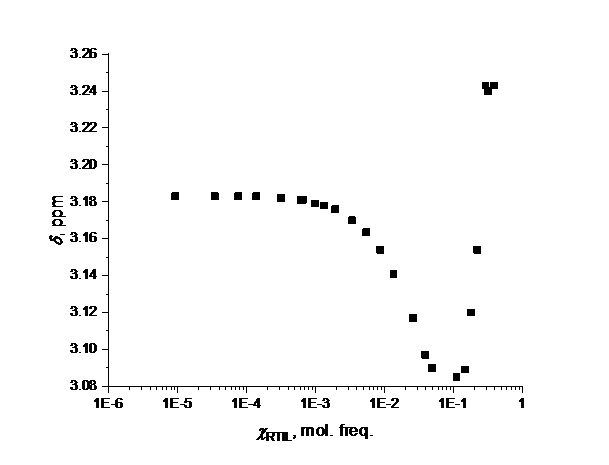
Finally, both [Ch][Lys] and [Ch][Try] increase glibenclamide’s solubility in water.