COMPARISON OF SPECTRAL PROPERTIES OFSEMICONDUCTOR STRUCTURES EQUIPPED WITH METALLIC (Ti/Au) OR N-TYPE GaAs METASURFACES
Barbora Škėlaitė1, 2, Vladislovas Čižas1, Kęstutis Ikamas3, Vytautas Jakštas4, Domas Jokubauskis1, Andrius Bičiūnas1, Andrzej Urbanowicz1, Marius Treideris4, Renata Butkutė1, Linas Minkevičius1, Ignas Grigelionis1
1 Center for Physical Sciences and Technology, Department of Optoelectronics, Vilnius, Lithuania
2 Vilnius University, Institute of Photonics and Nanotechnology, Vilnius, Lithuania
3 Vilnius University, Institute of Applied Electrodynamics and Telecommunications, Vilnius, Lithuania
4 Center for Physical Sciences and Technology, Department of Physical Technologies, Vilnius, Lithuania
Ever-growing field of terahertz (THz) technology require compact and easy to operate solid state thermal emitters. Currently most popular solutions comprise a considerably complicated structure and can operate only in cryogenic tempertatures [1]. Thermal emitters equipped with metasurfaces could be an attractive alternative. They can provide spectrally narrow resonant emission, operate at elevated temperatures [2] and do not require additional bulky and expensive external equipment. In this work two types of n-GaAs/GaAs semiconductor structures were investigated and compared. The first one consisted of 0.2 \(\mu\)m-thick Ti/Au metasurface, while the second was equipped with 5 \(\mu\)m-thick n-type GaAs metasurface. The metasurface structures were made up from periodic square shaped metacells to form a top layer of the thermal emitters.
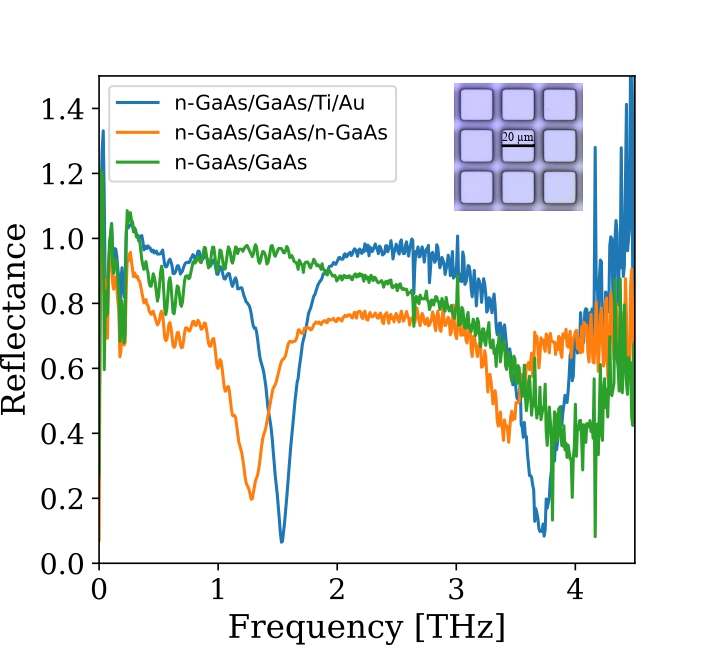
Fig. 1. Experimental reflection spectra of plain semiconductor (green) and semiconductor structures with n-GaAs metasurface (orange) and Ti/Au metasurface (blue). Insert shows metasurface of n-GaAs/GaAs/n-GaAs structure.
Thermal emitter structures equipped with metasurfaces were investigated both theoretically and experimentally to measure emittance, absorbance and reflectance spectra of the samples. From the obtained results it is seen, that by equipping semiconductor structures with metasurfaces the distinct spectral features appear if compared to bare n-GaAs/GaAs structures (Fig. 1). Both of the samples equipped with metasurfaces showed clear dependence of resonant frequency on the size of the metacell, where resonant frequency dropped with increasing metacell size. Moreover, thermal emitters equipped with metallic (Ti/Au) metasurfaces provided up to 30 % broader emission bandwidth compared to n-type GaAs metasurfaces.
Research was funded by Research Council of Lithuania (LMTLT), Project No. P-ST-23-213
[1] A. Leitenstorfer, et al., J. Phys. D: Appl. Phys. 56, 223001 (2023).
[2] F. Alves, et al., Opt. Express 20, 21025-21032 (2012).