
Polymer composites with carbon and metal nanoinclusions are a prospective class of materials, merging polymer processing technologies with the features of nanoparticles, such as excellent electric and thermal conductivity [1]. Hybrid composites containing two or more different types of fillers are particularly promising, as desired material properties can be achieved by using a lower concentration of fillers [2]. In carbon and metal reinforced composites, conductive filler particles form a percolative network in the dielectric polymer matrix, where charge transfer occurs via carrier hopping or tunnelling, and in the case of hybrid composites, the emergence of synergistic effects may result in different mechanisms of carrier transfer occurring simultaneously through multiple percolation networks [3].
Low frequency noise spectroscopy is an effective method for investigating charge carrier transport mechanisms in such materials, as filler-dependent charge carrier number fluctuations reflect in the observable electric noise spectra [4]. Of notable significance is 1/\(f\) noise, a superposition of many Lorentzian noise components in the material that exhibits a spectral density inversely proportional to the frequency, as the level of 1/\(f\) noise determines the limit of sensitivity for sensors [3].
The resistivity and low frequency (10 Hz – 20 kHz) noise characteristics of hybrid composites with single-walled carbon nanotubes (CNTs) and iron nanoinclusions (Fe, 800 nm) were investigated in a temperature range of (75–365) K to identify dominant charge transfer mechanisms. Composites were prepared via melt processing of polydimethylsiloxane (PDMS) and different concentrations of CNTs (0.5 wt.%) and Fe (65 wt.%, 75 wt.%, 82 wt.%).
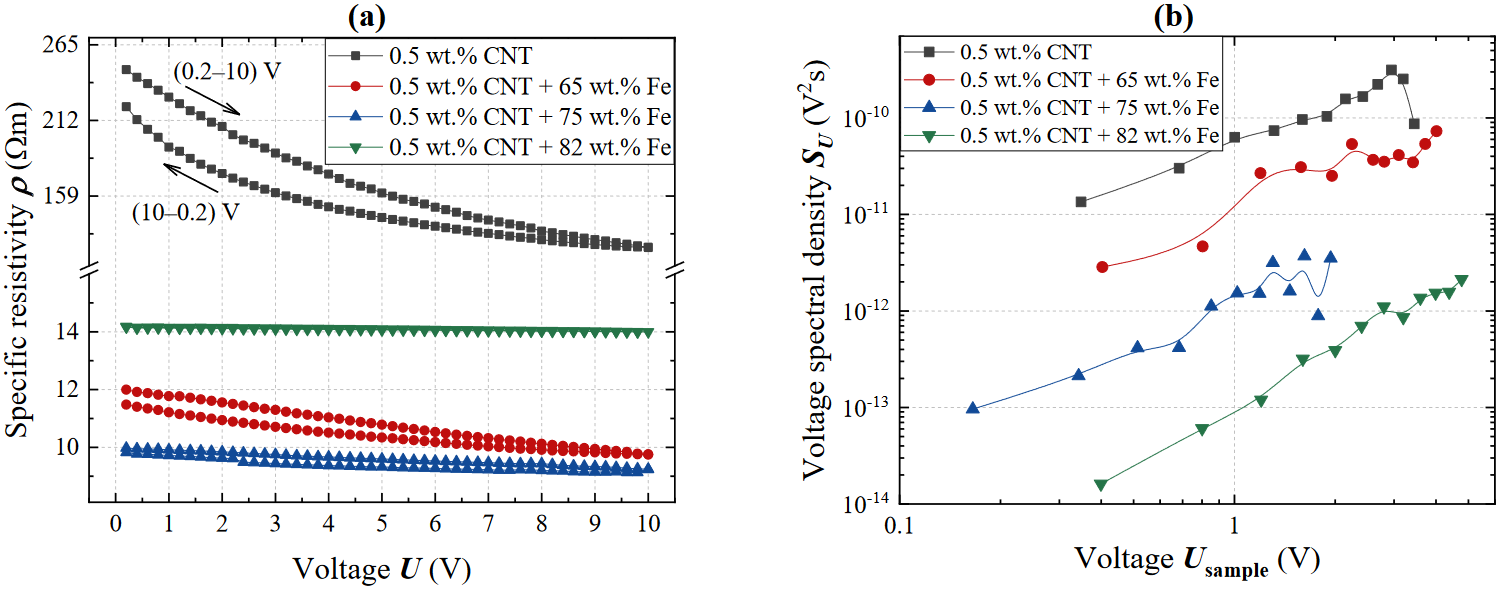
Low frequency voltage noise spectra consist of 1/\(f^\alpha\) noise and Lorentzian type components. For the proportionality of low frequency voltage noise spetral density to the voltage \(S_U \sim U^b\), the exponent \(b\) is lower than 2 (Fig. 1b). This indicates an increased contribution of tunneling processes [3]. The intensity of noise relates to the concentration of Fe in the composite, with composites with more Fe exhibiting lower levels of noise.