To transition from fossil fuels to more sustainable energy systems there should be more energy-storing solutions offered in the current market [1]. The most prominent and widely used are Lithium-ion batteries (LIB’s) which in recent years have become costly and deficient. To combat this problem new electrical energy storage solutions must be introduced into the current market. Sodium-ion batteries (SIB’s) are a good solution because of sodium’s abundance and low cost but to be offered in the current market their properties must match or be better than LIB predecessors [2]. For this to happen new research of SIB electrode materials must be conducted. The most prominent and widely used negative electrode materials is graphite but in order to offer better quality new negative electrode materials, the addition of various other compounds to graphite are being explored [3]. Iron sulfides could be an excellent addition to natural graphite because of its high theoretical capacity and low cost [4].
In this research work 4 methods of SIB negative electrode preparation with iron sulfides and natural graphite have been explored and compared. These electrodes were prepared using a hydrothermal method with different reagents used for iron sulfide synthesis and added natural graphite at 180°C temperature for 2 hours. The reagents used in the hydrothermal vessel for the sample preparation were:
- FeSO\(_{4}\) · 7H\(_{2}\)O, Na\(_{2}\)SO\(_{3}\), Graphite (Sample C/FeS1);
- FeSO\(_{4}\) · 7H\(_{2}\)O, Na\(_{2}\)S\(_{2}\)O\(_{3}\), S, Graphite (Sample C/FeS2);
- FeCl\(_{3}\) · 6H\(_{2}\)O, EtOAc, Thiourea, Graphite (Sample C/FeS3);
- FeSO\(_{4}\) · 7H\(_{2}\)O, Thiourea, Sulfur, Graphite (Sample C/FeS4).
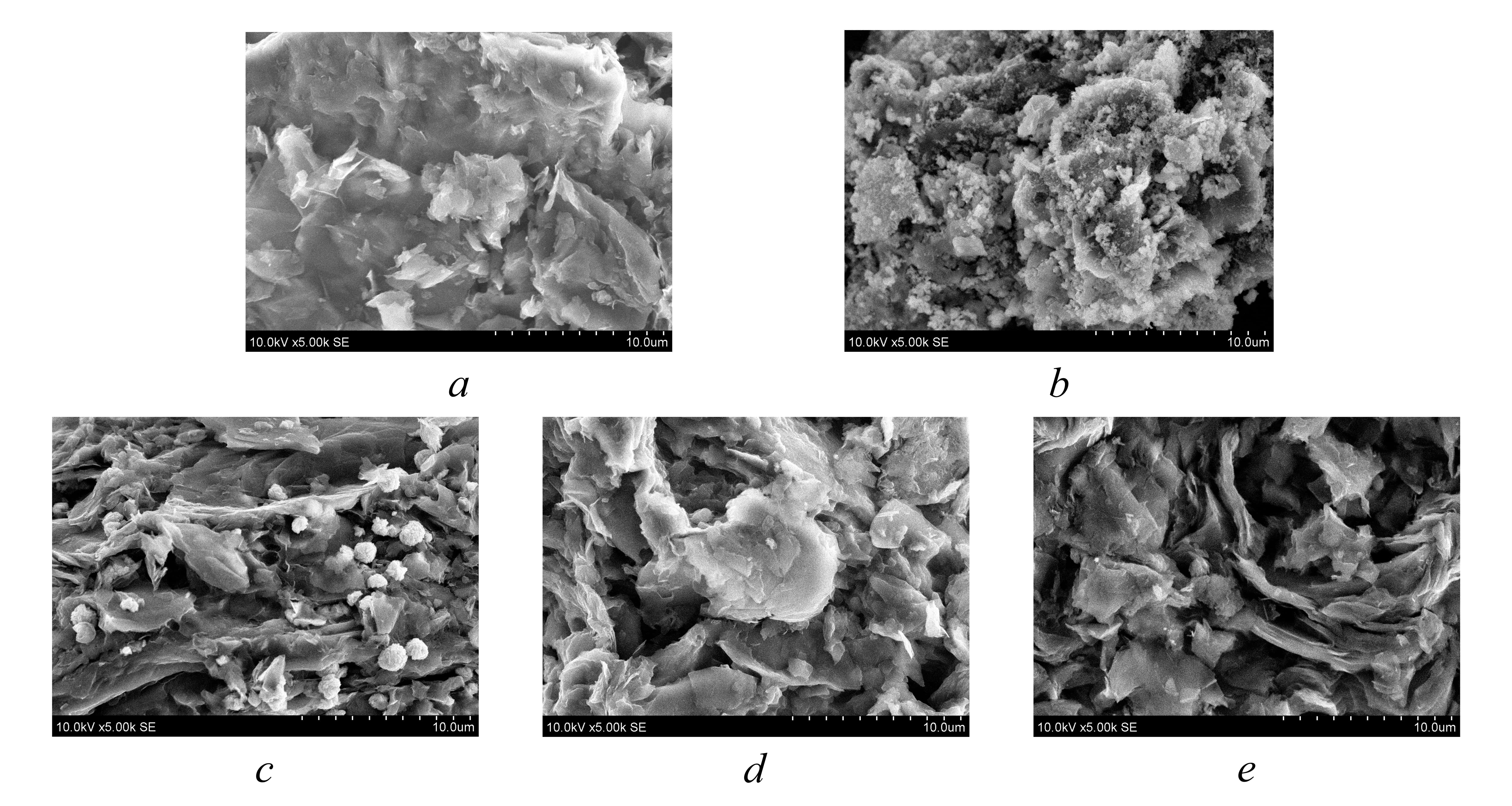
After carrying out obtained sample scanning electron microscopy (SEM) imaging samples indicated different properties when using different reagents for iron sulfide preparation. When comparing SEM results with natural graphite, samples C/FeS1 and C/FeS2 show clear changes on the surface and growth of FeS nanoparticles, which differ from those of natural graphite. Samples C/FeS3 and C/FeS4 SEM images don’t show clear growth of FeS nanoparticles, which could mean their form could resemble those of natural graphite.