This ion was selected for the investigation as it is of great importance to Astrophysics. It is evident that the lines can be observed in hot white dwarf stars [1]. In this work energy levels for Ba VI will be presented. The calculations for Ba VI are performed using general-purpose atomic structure package GRASP2018, based on multiconfiguration Dirac-Hartree-Fock and relativistic configuration interaction (RCI) methods.
As this ion is of Sb isoelectronic sequence, it was calculated using the same principle like in [2]. Active space (AS) method was used to compute radial wave functions layer by layer for four sets of virtual orbitals (AS\(_{1-4}\)). Single and double substitutions were done from multi reference set of orbitals up to 11s, 11p, 10d, 8f, 8g, 8h. Substitutions from [Kr]\({4d}^{10}\) core shells were forbidden. After calculating AS\(_{4}\), RCI method was used to further increase the accuracy of Ba VI energy level calculations. In total, 231 energy levels belonging to the configurations \(5s^2 5p 4f^2\), \(5s^2 5p^2 4f\), \(5s 5p^3 4f\), \(5p^5\), \(5s^2 5p^2 \{5d, 6p, 6s\}\), \(5s^2 5p^3\), \(5s^2 5p 5d^2\), \(5s 5p^3 5d\), \(5s 5p^3 6s\) and \(5s 5p^4\) were computed.
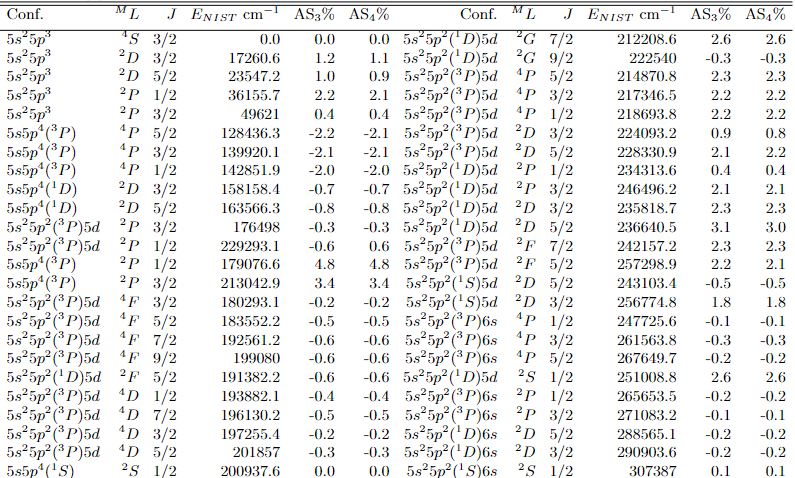
50 levels were selected based on the data availability at National Institute of Standards and Technology Atomic Spectra database (NIST) [3] for comparison. The relative difference to NIST data is displayed in Figure 1. The biggest disagreement is observed in \(5s^2 5p^2 5d\) and \(5s 5p^4\) configuration levels, as the energies appear to be reversed in our calculations. The average relative difference compared to NIST [3] for AS\(_{4}\) is 1.2%. In order to increase the accuracy of energy levels, core, core-valence, core-core correlations need to be investigated. During the conference further data from the calculations will be presented.